Online resources for crocheters

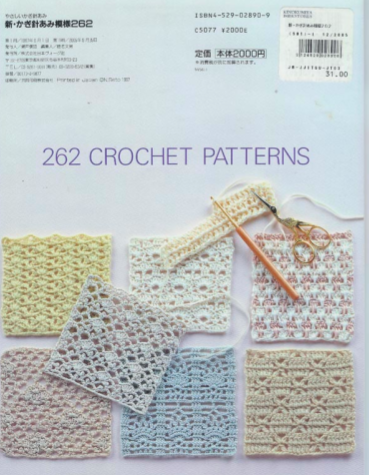
262 patterns

Hello my dear readers! Hope you are all doing great wherever you are. A few weeks ago I shared with you some books that I have found useful for crocheters and promised to be back with tips for online resources. It took a while but here it is!

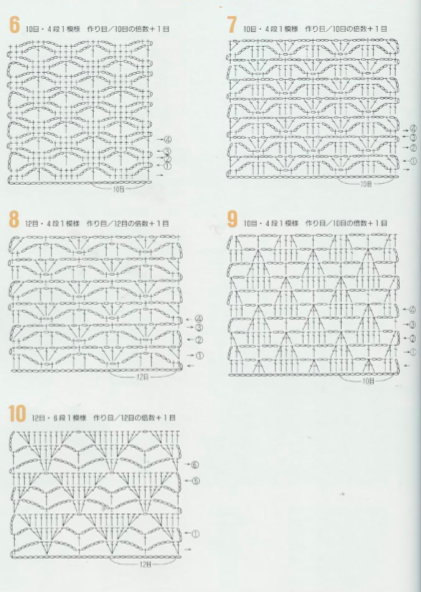
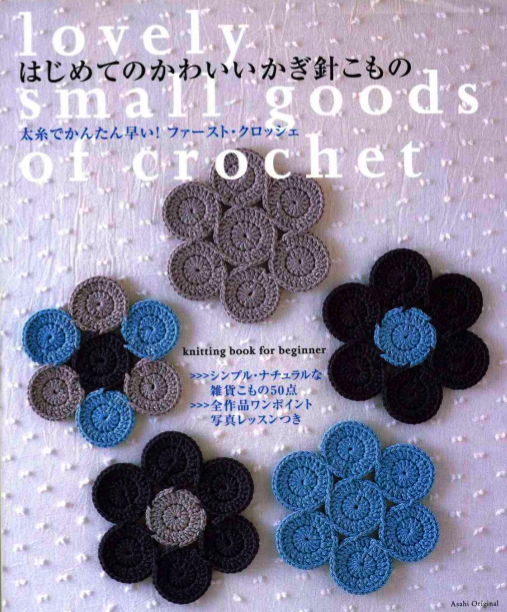
I definitely prefer actual books and magazines rather than the online version but sometimes obtaining the physical book is either expensive or just not possible, and you can find many free resources in the web. I will begin with Japanese stitch dictionaries: yes, they are in Japanese, but don’t fear! They are still a great tool. Here you have a couple available for download if you create an account at Issuu:

262 Crochet Patterns

300 Crochet Patterns

All the patterns come with charts and those are not hard to decipher, symbols are the same in any language and you can do a quick google search for Japanese crochet charts to find out all you need to know.

japanese patterns

Issuu is a great place to look for other publications, Japanese or not. Just type in “crochet” in the search bar and you will find loads of magazines and books to browse. Though most of them won’t be available for download you can still read them online. I have downloaded quite a few Japanese crochet magazines, they are so inspirational and all the patterns come with charts in case you want to give them a try.

japanese mag

Other great online resources are Craftsy classes. I have reviewed one and I am doing a series on another, most of them are paid but I haven’t mentioned they have free mini classes, one is currently available called Amazing Crochet Textures, the platform is really good so recommend you check it out.

Finally I would like to mention the free Interweave Ebooks. I have talked before about Interweave Crochet Magazine and they also have many free ebooks available for different techniques, such as crochet cables, tunisian crochet, felting, and much more. They usually explain the technique and include a few patterns to try it out, they are not always great patterns but it is free and allows you to learn by doing.

Hope that was useful and if you know of any other great resources for us crochet lovers feel free to share them in the comments!

x

Sol


Mitts!

photo 3

Hello everyone! Is it cold where you are? I haven’t taken my thicker coats out of the closet yet but I fear it won’t be long now. I have to say I do like winter and I love to have a cold Christmas (and the excuse to wear Xmas jumpers) but they are still difficult months when it is harder to get out of bed than ever since all you want is to stay in with your crochet and yarn.

My mum and my aunt are visiting me so I haven’t had time to do any crocheting or blogging but they are out doing some shopping so I wanted to show you how my mittens turned out. This pattern is from Bianca Boostra, it is called Velvet Olive Mittens and it appeared on Issue 57 of Inside Crochet. That issue has been one of my favourites, there are so many patterns I would love to give a try so be sure to check them out since you can buy back issues of this magazine.

photo 2

The pattern is easy to follow, I could never get the gauge right and tried with loads of different hooks but since they were for me it was easy to alter them as I went. I really like the effect with both colours and I am sure I will give them a lot of use in the soon to come Scottish winter.

You won’t hear much from me in the next week but hope to be back soon and pick up that vest again, my armhole swatch is half done and my fingers are itching to finish it! Will just have to wait… the only thing that comes before crochet is family I guess 🙂

x

Sol

Free Pattern: Uva Shawl

DSCN2545

Ravelry link

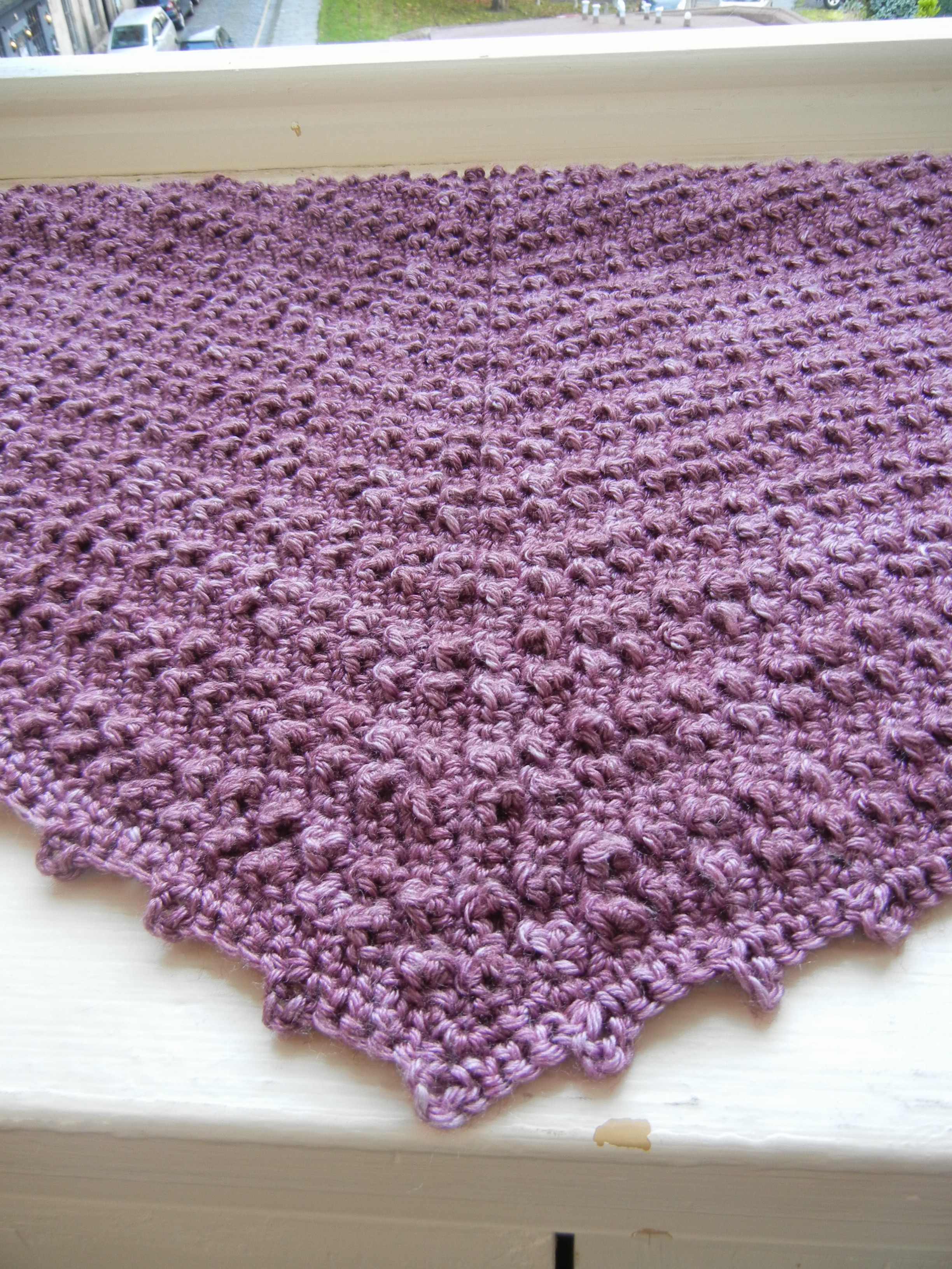
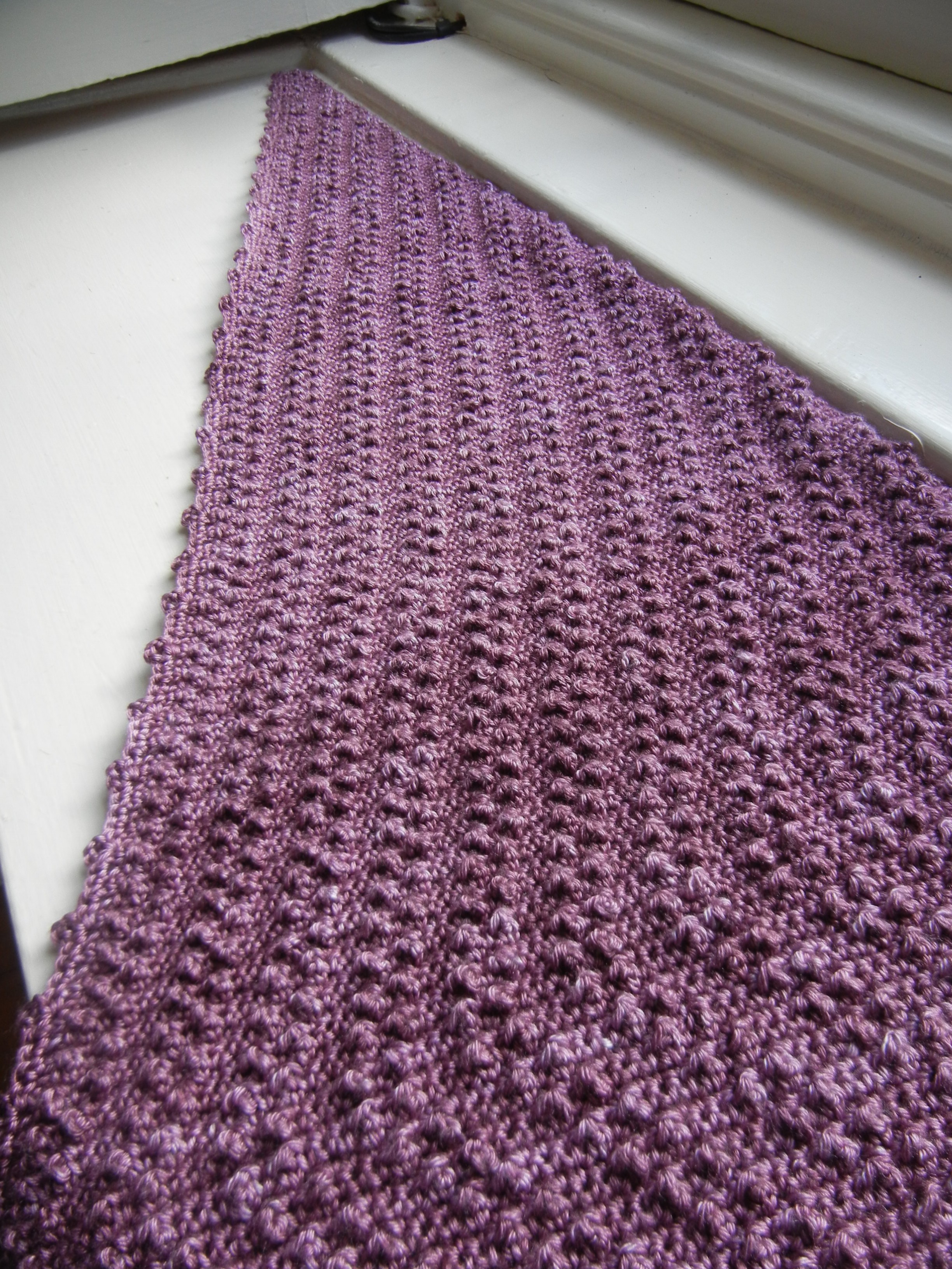
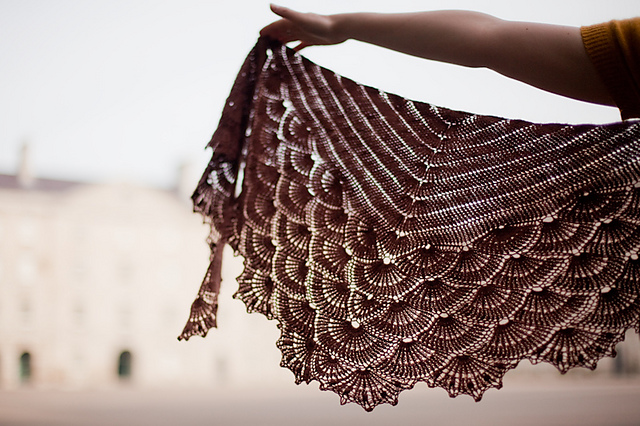
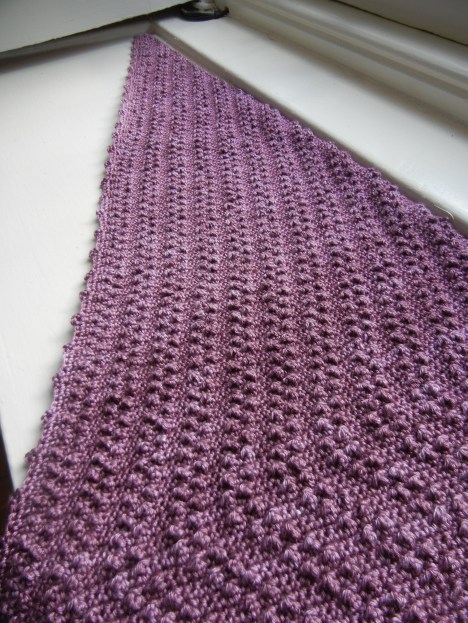
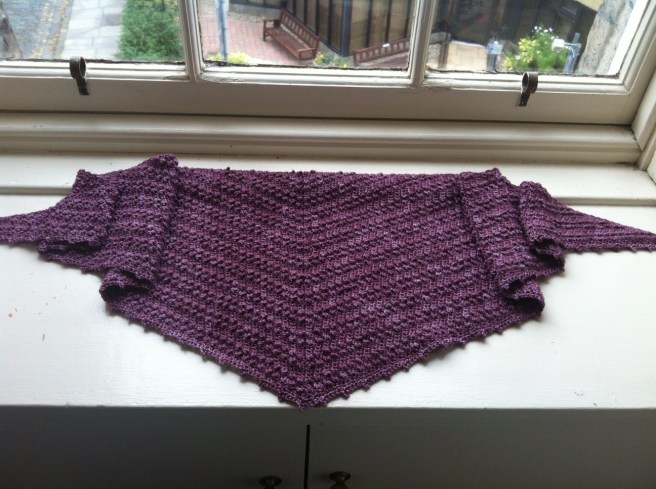
I am very excited to share another pattern with you, this time a shawl I have named “Uva” which means “grape” in Spanish. I just can’t help thinking of grapes when I look at it! This shawl uses just two stitches, dc and dtr, and it is so easy to make. I used Ginger’s Hand Dyed Splendor in Wine O’Clock (read about this yarn here) and I just love the final result.

DSCN2559

I mentioned I would recommend other yarns for this pattern that are a bit more budget friendly (but if you can buy this yarn I definitely recommend it), you could really use any other 4ply yarn, and even a DK one would still be OK, but here are some recommendations for my UK readers:

Yeoman Yarns Sport 4 ply – This yarn is 100% merino wool sold in 400gr cones for a bit less than 20 pounds, I have used it in shawls and it is lovely, great stitch definition. You will have plenty leftover to make other things with it as well.

Wendy Merino 4ply: This is a very nice yarn and it is sold in 50gr balls so that you can just get what you need for this project.

King Cole Merino Blend 4 ply: I used this yarn for my fingerless mitts and I think it is quite good for the price. You can buy it in balls or cones and some stores like Ginger Twist Studio sell them by weight (multiples of 50g) so that you can get just what you need.

Hope that helps 😉 And here is the pattern!

DSCN2547

Uva Shawl Pattern

This pattern has an increase section and a decrease section. Basically you are working the shawl sideways: you start on one end of the shawl with very few stitches and increase every two rows until you get to the middle section, then start decreasing until you have very few stitches again and get to the other end of the shawl.

The shawl measures 140cm long and it is 36cm at the widest part. Gauge is not very important, because of the way the shawl is constructed you can simply work up until you have a bit over half the yarn leftover and then start decreasing. If you prefer to work according to gauge you can work the pattern (one row of the stitch pattern repeat explained below followed by one row of dc). With a 3.5mm hook and 4ply yarn you should get 20 st and 22 rows in 10cmx10cm.

Materials

2 x 100g skeins Ginger’s Hand Dyed Splendor 4ply in Wine O’Clock (used 160gr/640m). See above for other yarn options.

3.5mm hook

Needle to weave in ends

Abbreviations

ch – chain

dc – UK double crochet

dtr – UK double treble

Stitch Guide

UK double treble: yarn over hook twice, insert hook in stitch, yarn over and pull up a loop, (yarn over pull through 2 loops on hook) 3 times.

dc2tog: insert hook in stitch, yarn over and pull up a loop, insert hook in next stitch, yarn over and pull up a loop, yarn over and pull through 3 loops on hook.
DSCN2572

Tip for an easier way to follow the pattern: 

Imagen 4This pattern is very simple an easy to follow without thinking about it much or counting the stitches in each row. The instructions are below and you can just follow each line all the way through the many rows but I thought I would share an easy way to do this pattern that you would find out eventually but why not save you some time!

Ok so, this pattern starts with an increase section and finishes with a decrease section. I will explain it for the increase one since it comes first and after understanding that one the decrease will come easy to you. When you are in the increase section yo do a row of the stitch pattern (let’s call that to the rows that have the little bobbles), followed by a row of dc in every stitch all the way until the last st where you do two dc, therefore you increase 1dc every two rows.

Now, the rows with the stitch pattern (with the bobbles) are very easy to do without thinking about them because there are no increases or decreases, and no matter in what part of the shawl you are a stitch pattern row will be a repeat of 6 stitches with just a couple of things to bear in mind.

Let’s see the 6 stitches: dtr, dc, dtr, dc, dc, dc (or dtr, dc, dtr, 3dc). Now imagine you are in ANY row where you do the stitch pattern repeat: You always ch 1 and dc in first st. Now start your 6-stitch-repeat (dtr, dc, dtr, 3dc) all the way until you get to the last st. No matter in what part of the 6-stitch-repeat you ended up, dc in the last dc and turn for the next row (which in the increase section will be an increase row and in the decrease section will be a decrease row). So that is all: dc in first st, dc in last st, and fill the space in between with as many repeats of the 6-stitch-repeat as you can fit, no matter if the last repeat is not a full one.

So let’s put it in practice so that you see how easy it is. Let’s say you are in Row 18 so you have just finished an increase row that left you with 11 sts to work.

So ch 1, dc in first st, start with the 6-stitch-repeat and stop when you have one stitch left: you do the repeat once, then start the second one: dtr, dc, dtr…. and then you have only one st left, so you stop the repeat and do a dc.

This is for EVERY stitch pattern row, even for the decrease section. In this section the only difference is that you do a decrease row instead of an increase row, meaning that you dc all the way through until the last two stitches, where you do a dc2tog.

I would advise you start following the pattern until Row 11 and then try this tip to continue working your shawl.

Notes

  • Beginning chain does not count as a st.
  • Turn your work after each row.
  • It doesn’t really matter if you chain 1 and then turn, or turn and chain 1. See what you like best and go with that.
  • Stitch number at end of row instruction corresponds to number of sts in that row. If this doesn’t appear in the row it means it has the same number of sts as the last one.
uva1

Instructions

Increase section
Ch4.

Row 1: dc in second ch from hook, 2dc. Turn (3 st).

Row 2: ch 1, 3dc. Turn.

Row 3: ch 1, 2dc, 2dc in last dc. Turn (4st).

Row 4: ch 1, dc in first dc, dtr, 2dc. Turn.

Row 5: ch 1, 3dc, 2dc in last dc. Turn (5st).

Row 6: ch 1, dc in first dc, (dtr, dc) two times, dc. Turn.

Row 7: ch 1, 4dc, 2dc in last dc. Turn (6st).

Row 8: ch 1, dc in first dc, (dtr, dc) two times, dc. Turn.

Row 9: ch 1, 5dc, 2dc in last dc. Turn (7st).

Row 10: ch 1, dc in first dc, (dtr, dc) two times, 2dc. Turn.

Row 11: ch 1, 6dc, 2dc in last dc. Turn (8st).

Row 12: ch 1, dc in first dc, (dtr, dc) two times, 3dc. Turn.

Row 13: ch 1, 7dc, 2dc in last dc. Turn (9st).

Row 14: ch 1, dc in first dc, (dtr, dc) two times, 2dc, dtr, dc. Turn.

Row 15: ch 1, 8dc, 2dc in last dc. Turn (10st).

Row 16: ch 1, dc in first dc, (dtr, dc) two times, 2dc, dtr, 2dc. Turn.

Row 17: ch 1, 9dc, 2dc in last dc. Turn (11st).

Row 18: ch 1, dc in first dc, (dtr, dc) two times, 2dc, (dtr, dc) two times. Turn.

Row 19: ch 1, 10dc, 2dc in last dc. Turn (12st).

Row 20: ch 1, dc in first dc, (dtr, dc) two times, 2dc, (dtr, dc) two times, dc. Turn.

Row 21: ch 1, 11dc, 2dc in last dc. Turn (13st).

Row 22: ch 1, dc in first dc, (dtr, dc) two times, 2dc, (dtr, dc) two times, 2dc. Turn.

Row 23: ch 1, 12dc, 2dc in last dc. Turn (14st).

Row 24: ch 1, dc in first dc; *dtr, dc, dtr, 3dc, rep from * until last st, dc in last dc. Turn.

Row 25: ch 1, dc in each st across until last st, 2dc in last dc. Turn (15st)

Row 26: ch 1, dc in first dc; *dtr, dc, dtr, 3dc, rep from * until last 2 st, dtr, dc in last dc. Turn.

Row 27: ch 1, dc in each st across until last st, 2dc in last dc. Turn (16st)

Row 28: ch 1, dc in first dc; *dtr, dc, dtr, 3dc, rep from * until last 3 st, dtr, 2dc. Turn.

Row 29: ch 1, dc in each st across until last st, 2dc in last dc. Turn (17st)

Row 30: ch 1, dc in first dc; *dtr, dc, dtr, 3dc, rep from * until last 4 st, (dtr, dc) two times. Turn.

Row 31: ch 1, dc in each st across until last st, 2dc in last dc. Turn (18st)

Row 32: ch 1, dc in first dc; *dtr, dc, dtr, 3dc, rep from * until last 5 st, (dtr, dc) two times, dc in last dc. Turn.

Row 33: ch 1, dc in each st across until last st, 2dc in last dc. Turn (19st)

Row 34: ch 1, dc in first dc; *dtr, dc, dtr, 3dc, rep from * across. Turn.

Row 35: ch 1, dc in each st across until last st, 2dc in last dc. Turn (20st)

Repeat Rows 24 to 35 (twelve rows) nine times. You will have 143 rows in total and 74 sts in Row 143.

Row 144: ch 1, dc in first dc; *dtr, dc, dtr, 3dc, rep from * until last st, dc in last dc. Turn.

Row 145: ch 1, dc in each st across until last st, 2dc in last dc. Turn (75st)

Row 146: ch 1, dc in first dc; *dtr, dc, dtr, 3dc, rep from * until last 2 st, dtr, dc in last dc. Turn.

Row 147: ch 1, dc in each st across until last st, 2dc in last dc. Turn (76st)

Row 148: ch 1, dc in first dc; *dtr, dc, dtr, 3dc, rep from * until last 3 st, dtr, 2dc. Turn.

Row 149: ch 1, dc in each st across. Turn (76st)


Decrease Section

Row 1: ch 1, dc in first dc; *dtr, dc, dtr, 3dc, rep from * until last 3 st, dtr, 2dc. Turn.

Row 2: ch 1, dc in each st across until last st, dc2tog in last two st. Turn (75st).

Row 3: ch 1, dc in first dc; *dtr, dc, dtr, 3dc, rep from * until last 2 st, dtr, dc in last dc. Turn.

Row 4: ch 1, dc in each st across until last st, dc2tog in last two st. Turn (74st).

Row 5: ch 1, dc in first dc; *dtr, dc, dtr, 3dc, rep from * until last st, dc in last dc.

Row 6: ch 1, dc in each st across until last st, dc2tog in last two st. Turn (73st).

Row 7: ch 1, dc in first dc; *dtr, dc, dtr, 3dc, rep from * across. Turn.

Row 8: ch 1, dc in each st across until last st, dc2tog in last two st. Turn (72st).

Row 9: ch 1, dc in first dc; *dtr, dc, dtr, 3dc, rep from * until last 5 st, (dtr, dc) two times, dc in last dc. Turn.

Row 10: ch 1, dc in each st across until last st, dc2tog in last two st. Turn (71st).

Row 11: ch 1, dc in first dc; *dtr, dc, dtr, 3dc, rep from * until last 4 st, (dtr, dc) two times. Turn.

Row 12: ch 1, dc in each st across until last st, dc2tog in last two st. Turn (70st).

Repeat Rows 1 to 12 nine times, you will have 120 rows in total and will finish Row 120 with 16 st.

Row 121: ch 1, dc in first dc; *dtr, dc, dtr, 3dc, rep from * until last 3 st, dtr, 2dc. Turn.

Row 122: ch 1, dc in each st across until last st, dc2tog in last two st. Turn (15st).

Row 123: ch 1, dc in first dc; *dtr, dc, dtr, 3dc, rep from * until last 2 st, dtr, dc in last dc. Turn.

Row 124: ch 1, dc in each st across until last st, dc2tog in last two st. Turn (14st).

Row 125: ch 1, dc in first dc; *dtr, dc, dtr, 3dc, rep from * until last st, dc in last dc. Turn.

Row 126: ch 1, dc in each st across until last st, dc2tog in last two st. Turn (13st).

Row 127: ch 1, dc in first dc, (dtr, dc) two times, 2dc, (dtr, dc) two times, 2dc. Turn.

Row 128: ch 1, dc in each st across until last st, dc2tog in last two st. Turn (12st).

Row 129: ch 1, dc in first dc, (dtr, dc) two times, 2dc, (dtr, dc) two times, dc. Turn.

Row 130: ch 1, dc in each st across until last st, dc2tog in last two st. Turn (11st).

Row 131: ch 1, dc in first dc, (dtr, dc) two times, 2dc, (dtr, dc) two times. Turn.

Row 132: ch 1, dc in each st across until last st, dc2tog in last two st. Turn (10st).

Row 133: ch 1, dc in first dc, (dtr, dc) two times, 2dc, dtr, 2dc. Turn.

Row 134: ch 1, dc in each st across until last st, dc2tog in last two st. Turn (9st).

Row 135: ch 1, dc in first dc, (dtr, dc) two times, 2dc, dtr, dc. Turn.

Row 136: ch 1, dc in each st across until last st, dc2tog in last two st. Turn (8st).

Row 137: ch 1, dc in first dc, (dtr, dc) two times, 3dc. Turn.

Row 138: ch 1, dc in each st across until last st, dc2tog in last two st. Turn (7st).

Row 139: ch 1, dc in first dc, (dtr, dc) two times, 2dc. Turn.

Row 140: ch 1, dc in each st across until last st, dc2tog in last two st. Turn (6st).

Row 141: ch 1, dc in first dc, (dtr, dc) two times, dc. Turn.

Row 142: ch 1, dc in each st across until last st, dc2tog in last two st. Turn (5st).

Row 143: ch 1, dc in first dc, (dtr, dc) two times, dc. Turn.

Row 144: ch 1, dc in each st across until last st, dc2tog in last two st. Turn (4st).

Row 145: ch 1, dc in first dc, dtr, 2dc. Turn.

Row 146: ch 1, dc in each st across until last st, dc2tog in last two st. Turn (3st).

Row 147: ch 1, 3dc. Turn.

Row 148: ch 1, dc in first dc, dc2tog in last two st. (2st).

Don’t cut yarn.


Edging 

With right side of shawl facing you, turn to work on bottom edge of the shawl.

Row 1: ch 1, 1dc per row until middle of the shawl (Row 149), 3dc, 1dc per row until the end. Turn (301 sts). Don’t worry too much about where you do the dc and it is fine if you miss a row at some point, try to get the amount of stitches required to get the edge to match up better, though it is not the end of the world if it doesn’t 😉

Row 2: ch 1, *(dc, ch3, dc) in next st, skip 1dc, 3dc, repeat from * until last st, (dc, ch 3, dc) in last st.

Fasten off.

Block lightly (steam block or pin it to the size you want, spray it with some water and let it dry).


As usual, please let me know if you have any questions, hope you like it!

x

Sol
Books in my journey

Hello my dear readers! I am enjoying this Saturday very much, it is sunny outside after a lot of rain, my shawl is being blocked as I write (so excited!), I bought a lovely tea from Eteaket that is just sooo nice and I am looking forward to an evening of relaxing and catching up with shows (anyone else caught up with Outlander? Episode 3 here I come!).

I wanted to talk about books today and share which ones have been useful to me in this crochet journey of mine. In a world that is getting more and more digitalised it is hard to hold on to paper books sometimes, but not all books are digital so I still use paper books to learn about new techniques or use as reference. I will do another post with online resources I use for crochet (including ebooks), specifically for finding crochet stitches so keep an eye out for it if you are interested.

Before I get on to it I just want to mention that I got access to all these books (except one) through my local library, so make sure you check your library to see what they have in their catalogue.

The first book I want to mention is Crochet Stitches Visual Encyclopedia, by Robyn Chachula.

9781118171653

If you don’t have a crochet stitches dictionary I really recommend this one, books like this really open up a world of possibilities for new projects. When I first got it I used to try stitches out by making a cowl with the ones I liked, a simple and easy project that allows you to see how the stitch feels and looks and that you can actually wear after you are done. I like this book because it has loads of lovely stitches, it is organised into clear chapters (including one for tunisian crochet stitches), the instructions are clear and you get a chart for each stitch as well. You also get granny squares, motifs and edgings so you are covered for all crochet stitch necessities!

Next, as you may have guessed, I have a tunisian crochet book: Tunisian Crochet: The look of knitting with the ease of crocheting by Sharon Hernes Silverman. This was the book that first introduced me to this technique. I was browsing in the crafts section of my library when I saw the title and was instantly intrigued: the look of knitting but without the hassle of knitting? You may disagree completely with me but I have always found crochet easier than knitting, and a lot more forgiving with mistakes as well. I do like how knitting looks so this sounded like the perfect combination and it is! If you follow my blog you know I love tunisian crochet and it was this book that taught me how to do it (plus a few youtube videos here and there). It also includes patterns for projects, and even though I didn’t like them all, my first ever tunisan crochet project was a lovely cushion from this book. So if you find this in your library catalogue I would recommend you take a look.

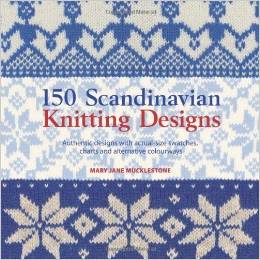
My other current obsession at the moment is fair isle crochet. Even though I haven’t found any books for this technique with crochet you don’t really need them with all the great books for fair isle knitting. The principle is the same: create a chart and knit it or crochet it, so if you are looking to create your own charts to crochet I would recommend the following:


scandinavian

fair isle designs

colourwork stitches

They all have loads of different charts that you can mix and adapt and they also show knitted swatches of each. I particularly like the first one, 150 Scandinavian Knitting Designs by Mary Jane Mucklestone, it has some lovely charts to play with.

So there you have it! Hope you find it useful and that you find some of these in your local library, go have a nosey 🙂

Now that the shawl is finished I will post the pattern for it soon, I will also post about this new Craftsy class I am taking and the lovely yarn and hooks I bought because of it!

Have a great weekend 😀

x

Sol


Free pattern and tutorial: Autumn Diamonds Part II

DSCN2532

Hello my dear readers! Hope you had a great week. I have been a very busy bee and have just managed to finish the second part of the tutorial for my fair isle mitts. Not long to go but the thumb needs some further explanation. Let’s jump right into it!

Autumn Diamonds Tutorial Part II

Size and gauge

Circumference: 20 cm

Gauge: Crochet 11 waistcoat stitches and 13 rows with a 4mm hook to obtain 5cmx5cm.

Gauge in this pattern is not essential. Fair isle chart is repetitive and you can add necessary stitches for your size and fill in the pattern in a way that satisfies you.

Materials

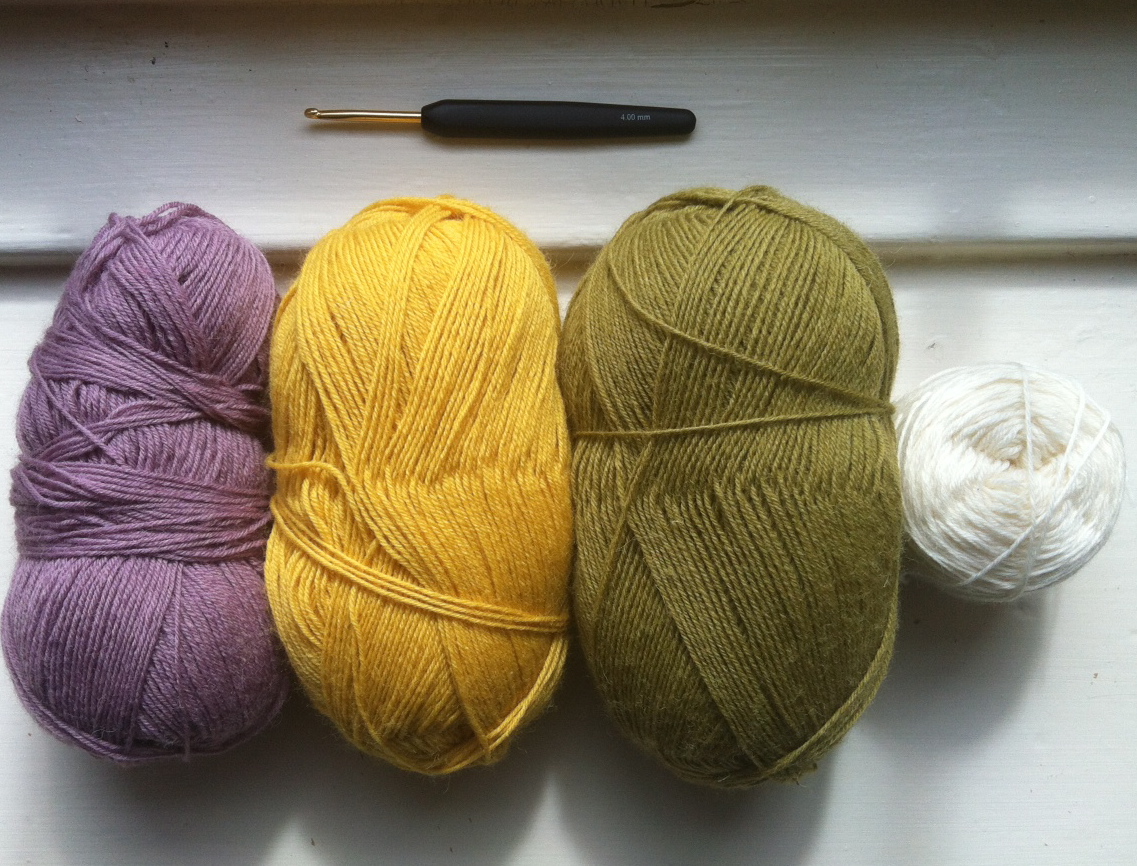
50g King Cole Merino in Aran (Colour A)

West Yorkshire Spinners Signature 4 ply – 1 ball in Pennyroyal (Colour B), 1 ball in Butterscotch (Colour C), 1 ball in Cardamom (Colour D) –> You will use VERY little of the last two yarns so you could use something from your stash if you don’t want to spend  more on them.

4mm hook

Needle to weave in ends

Instructions

I have a new chart for the rest of the pattern. As usual you read it bottom-up, right to left and every stitch is a wst unless it has a “dc” in which case it is a UK double crochet. I know it looks mad, but I explain everything below. If you have followed the instructions of pulling tight when you sl st and ch 1 then your seam should be almost invisible, if not try pulling harder!

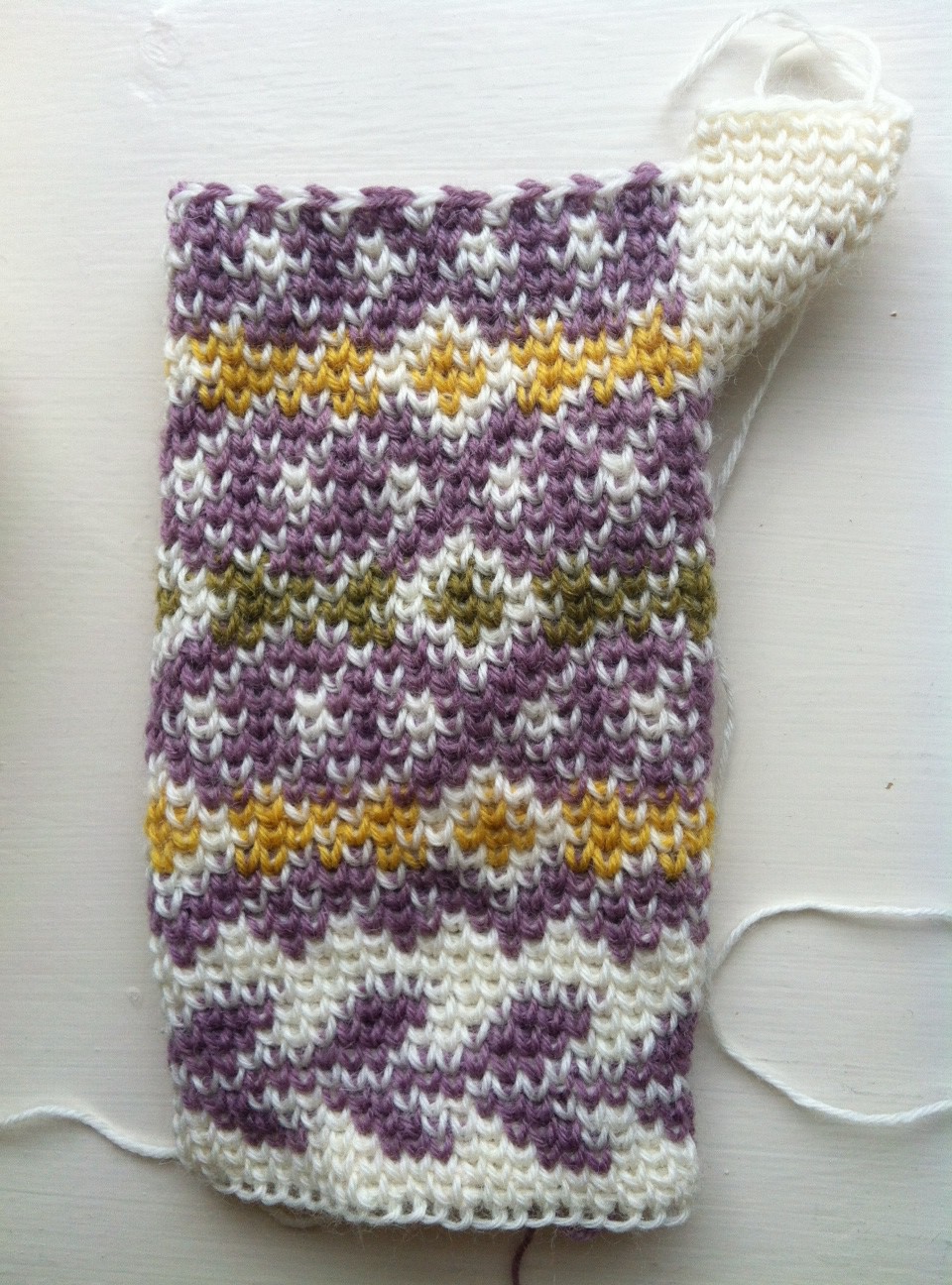
1. If you have followed the first part of this tutorial your mitten should look something like this.

1

2. Now we will start shaping the thumb. You will do this by adding two stitches per round, one at the beginning and the other at the end. So you have finished Round 35, joined with a sl st to first st and chained 1 (remember to pull tight)…

3

3. Now for Round 36 we will do the first increases. Instead of starting the round by making a wst, you will do a normal dc in the first st. So insert your hook in the first st…

4

4. And crochet a dc.

5

6

5. If you look at the chart the stitches that are dc are marked. Now you can continue the rest of the round following the chart using wst until the last st of the fair isle pattern which is yellow. Since the next increase stitch is white you will need to change colours before finishing.

8

9

10

6. The increase now is made by doing another wst in the same st as the last you made.

11

12

13

7. Sl st to first st, ch 1 and pull tight.

14

8. For Round 37 we increase again on the first and last st. So make a dc in the first st…

15

16

9. Now, the next stitch is the first increase we made in the last round, so it is part of the thumb and therefore it is a white st as well and also a wst since it doesn’t have a “dc” on the chart. So make a wst in the next stitch…

17

18

27

10. After the two stitches of the thumb continue with the chart until the last st of the main fair isle pattern, which is in yellow. Now the next st corresponds to the increase of the last round. Make a wst there…

19

20

21

11. … and then make another wst in the same st. This is the second increase of the round, now you have 4 st that make the thumb.

22 23

24

12. Sl st and ch 1. The main fair isle pattern will always have 42 st, but you will continue to add 2 st per round this way until you have 14 st on the thumb. Make sure you keep those 42 st for each round, for some rounds the fair isle pattern starts or finishes with white so it is easy to miss a st. Continue until Round 42, your thumb should look like this, with 14 st.

25

26

13. For Round 43 and 44 you will keep the same number of stitches for the thumb, so the first st in the round is no longer a dc, but a wst. Continue with Rounds 43 and 44 with no increases.

40

14. In Round 45 we will separate the thumb from the rest of the pattern. Your thumb should look like this.

41

15. Start Round 45 with 7 wst as the chart indicates.

42

16. Then instead of continuing with the fair isle pattern, you are going to do the next wst on the other side of the thumb.

a

b

17. Continue with the next 6 wst.

d

18. Slip st to first st and ch 1.

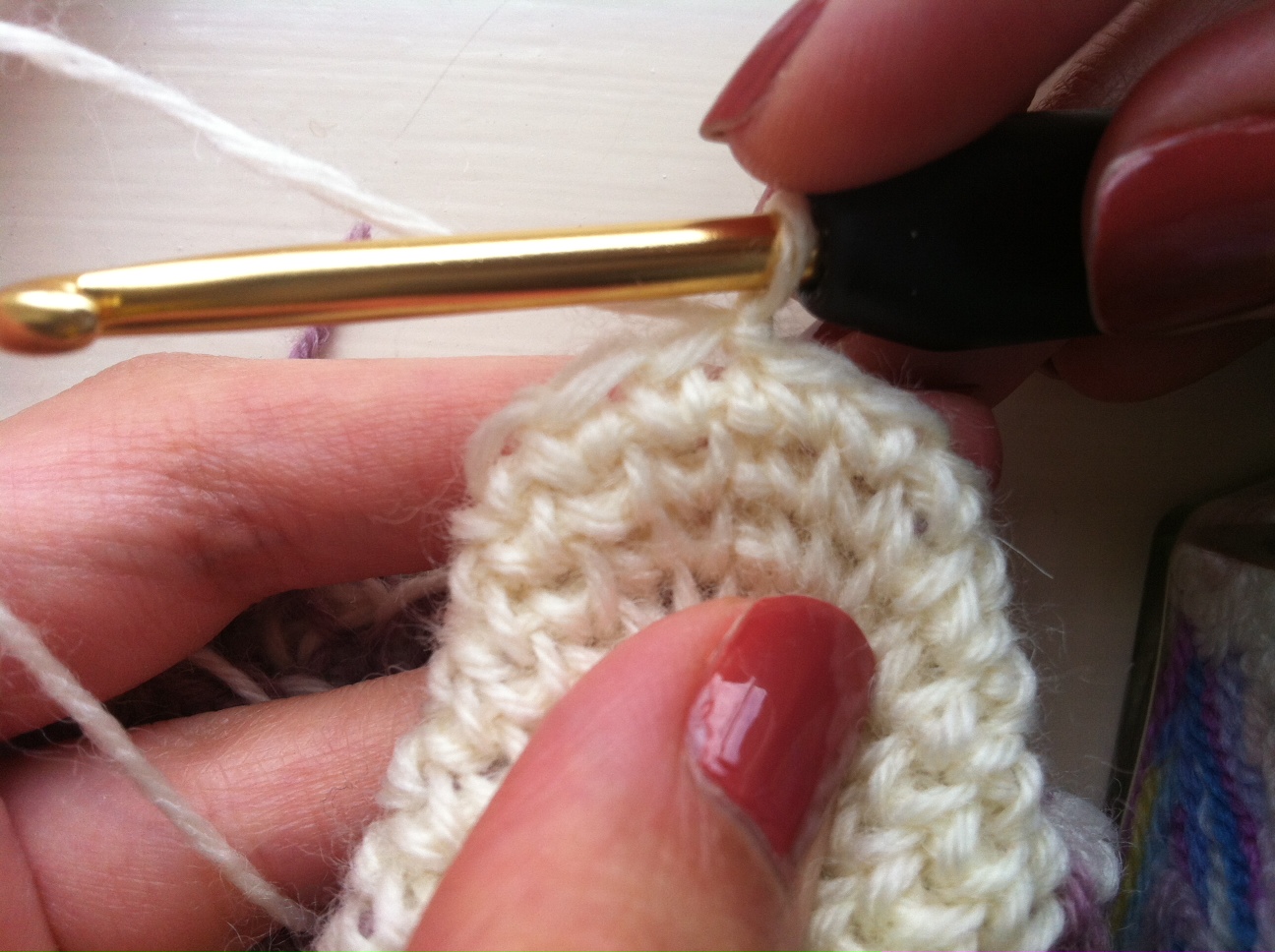
e

19. You will work the next two rounds of the thumb making 1 wst in each of the 14 st. When you finish the second round (third round of thumb separated from rest of pattern), sl st to first st. Fasten off. Your mitt will look like this so far.
36
35
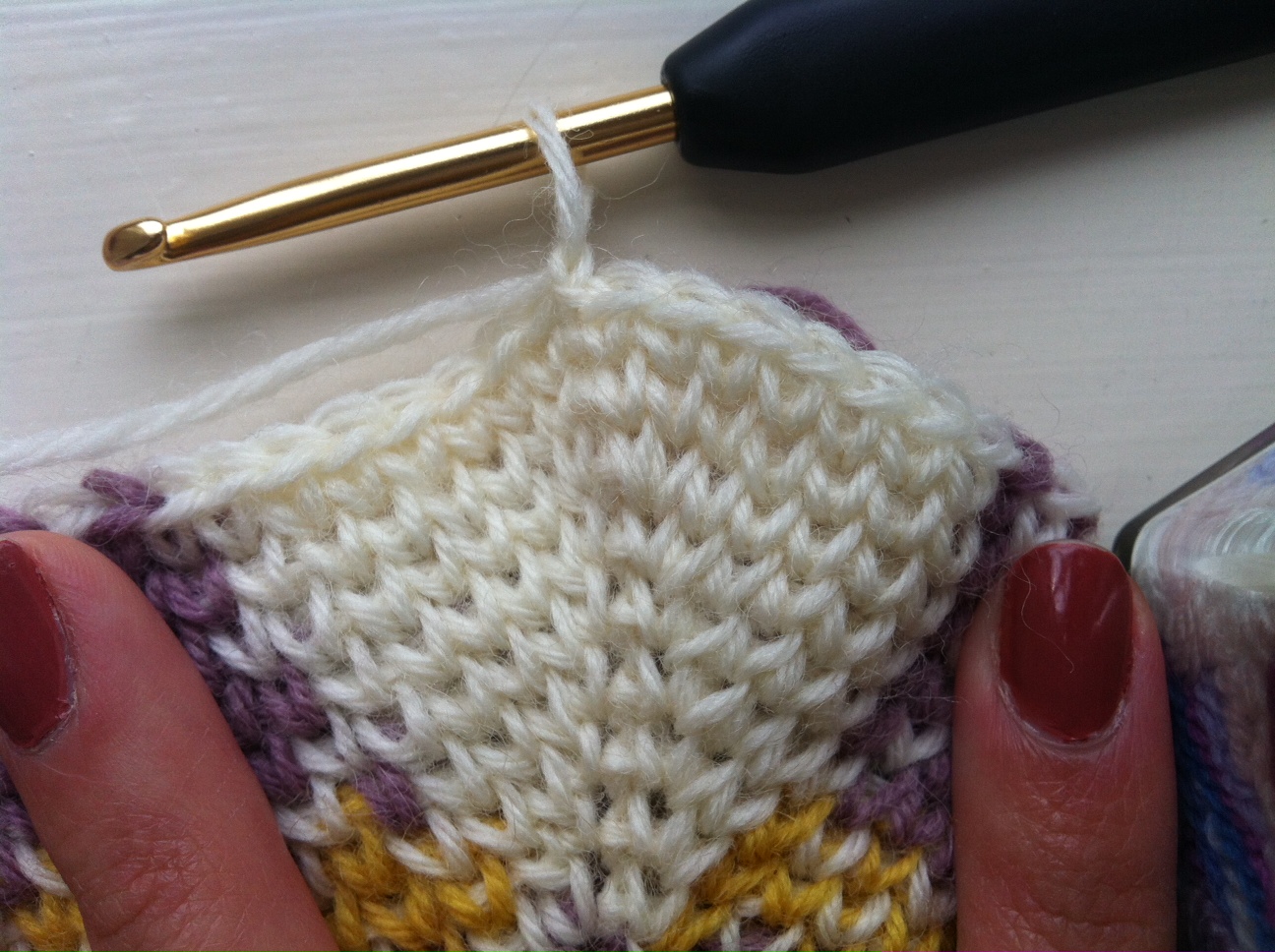
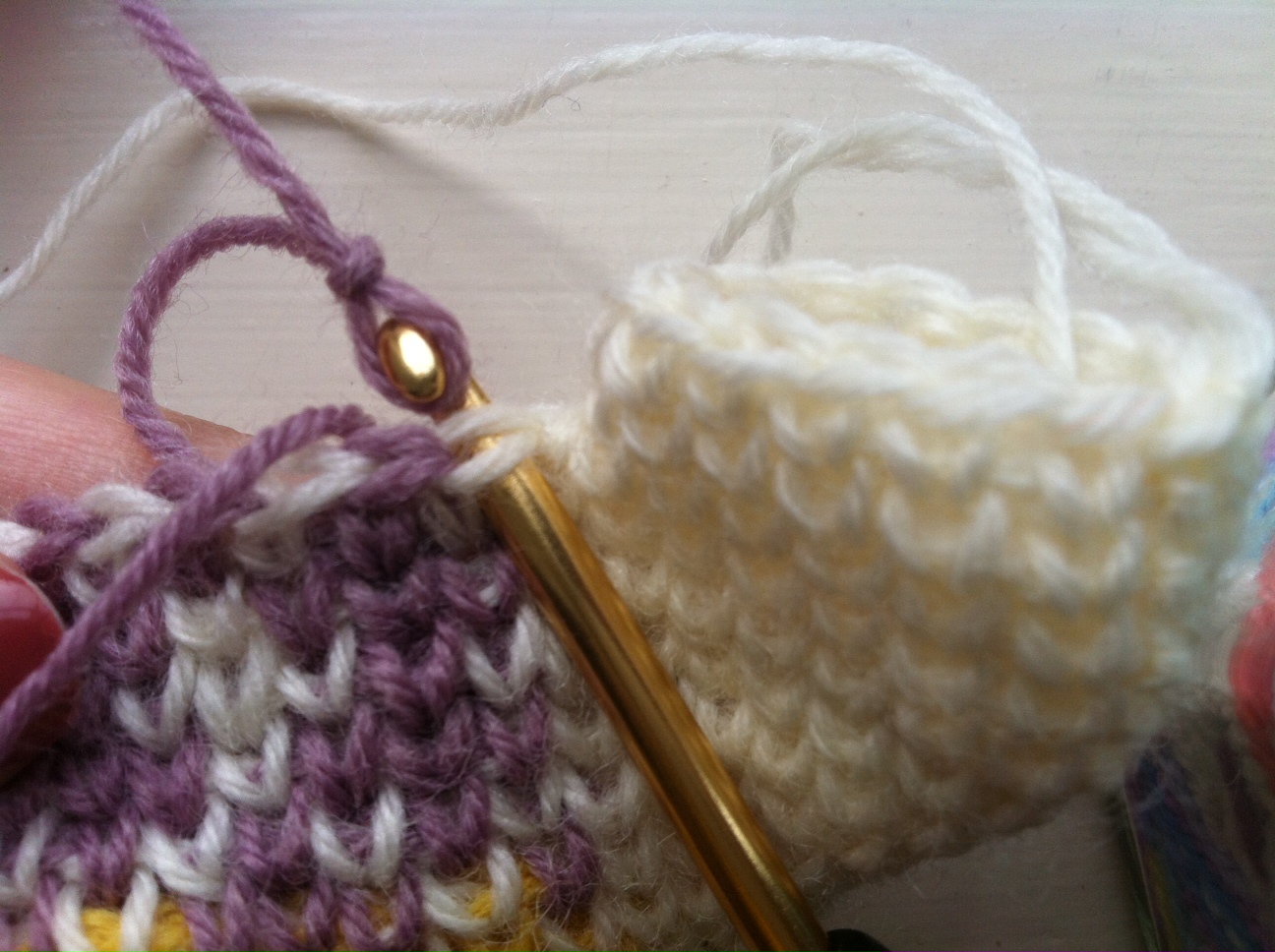
 20. Now we just need to finish the rest of the fair isle pattern, so we have to go back to Round 45 of the chart, which begins with a st in purple. So insert your hook in the first st of the fair isle chart (as you would normally underneath the two strands that make the ch), then make a slip knot with the purple colour…
37
38
21. … Pull it through, yarn over and pull through one loop on hook. Pull tight and now you can begin the first wst as usual.
55
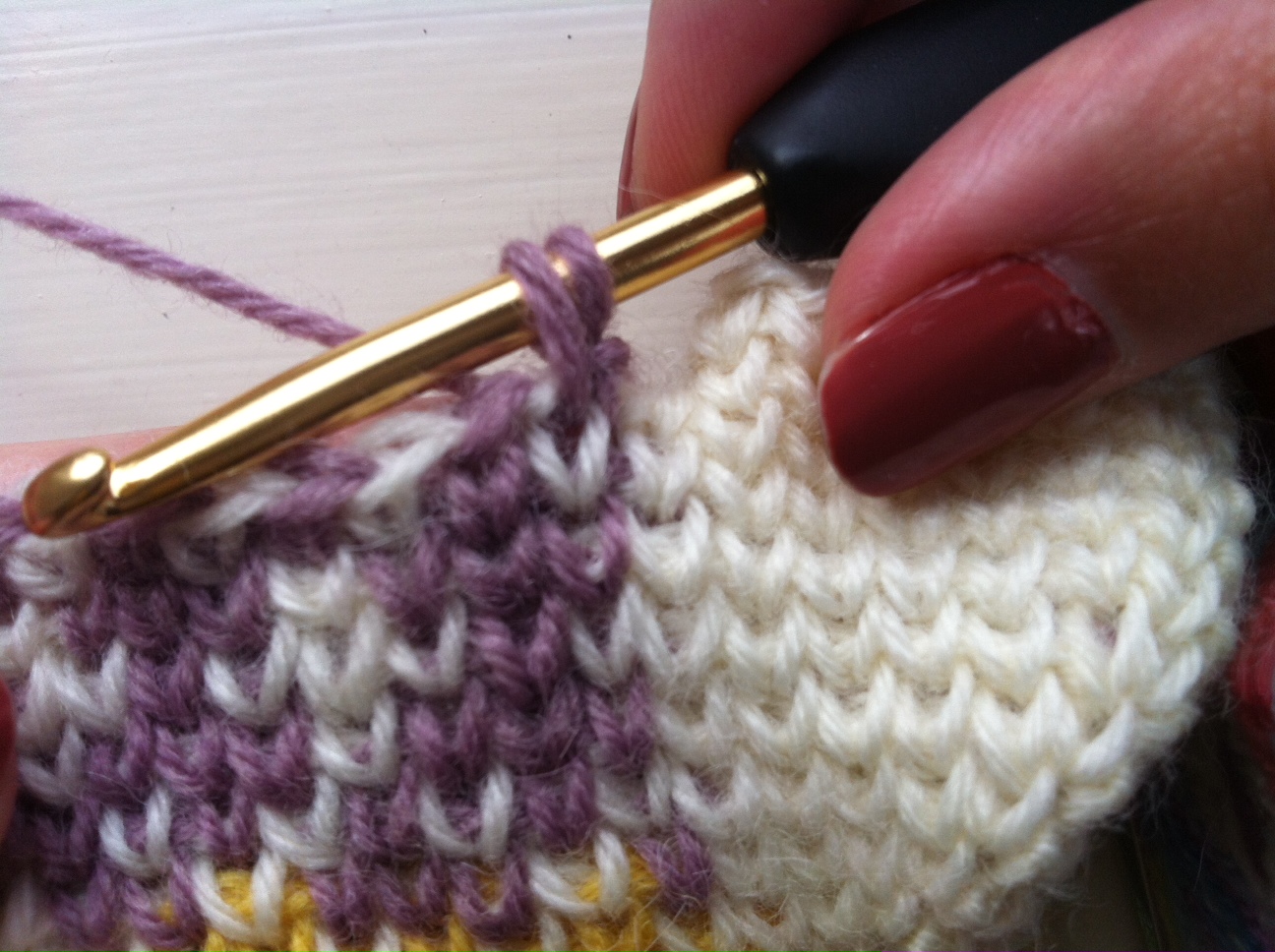
22. Insert your hook in between the strands that make the V and pull up a loop.
56
23. Next st is in white but we need to add this yarn since we cut the white we were using when we finished the thumb. So with the 2 loops on the hook make a slip knot with the white…
57
24. … and pull through both loops on hook.
58
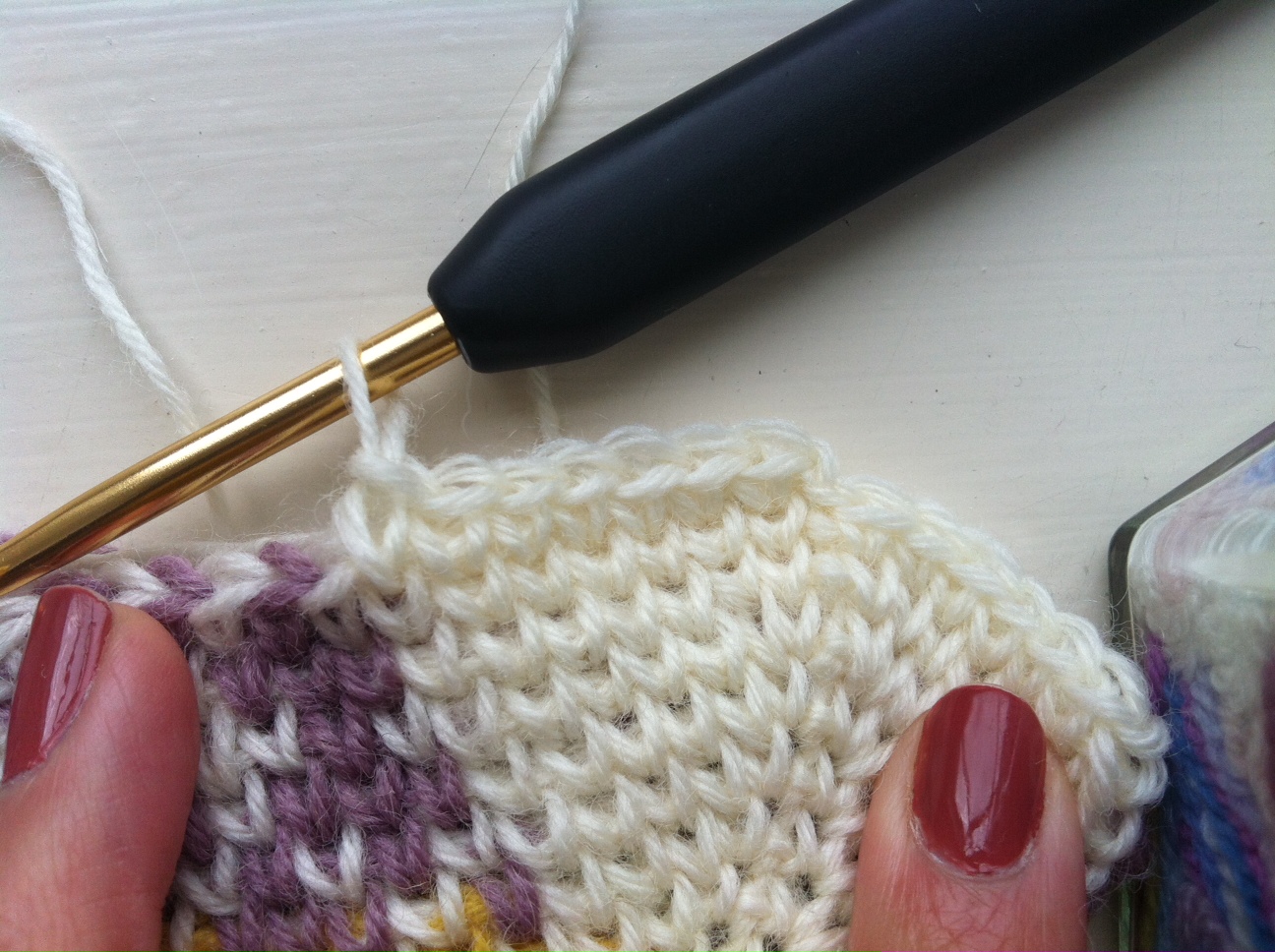
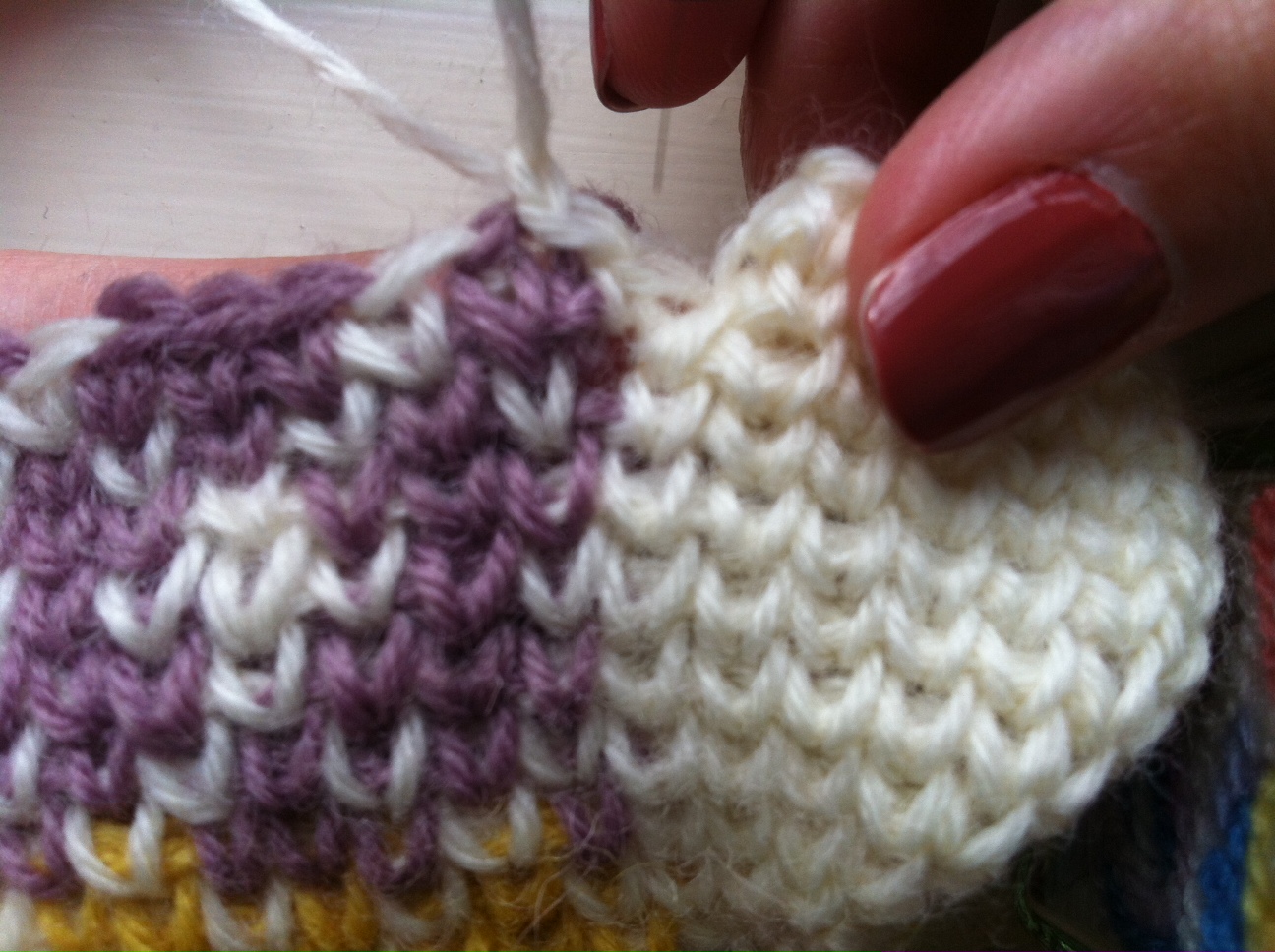
25. Continue the fair isle chart until the last st of Round 45. Now, before we join with the first st of this round, we will do a small trick to make sure that there is not a big hole where the join is.
47
26. Insert your hook in the white st of the thumb closest to the last st you made…
48
27. … and make a dc.
49
50
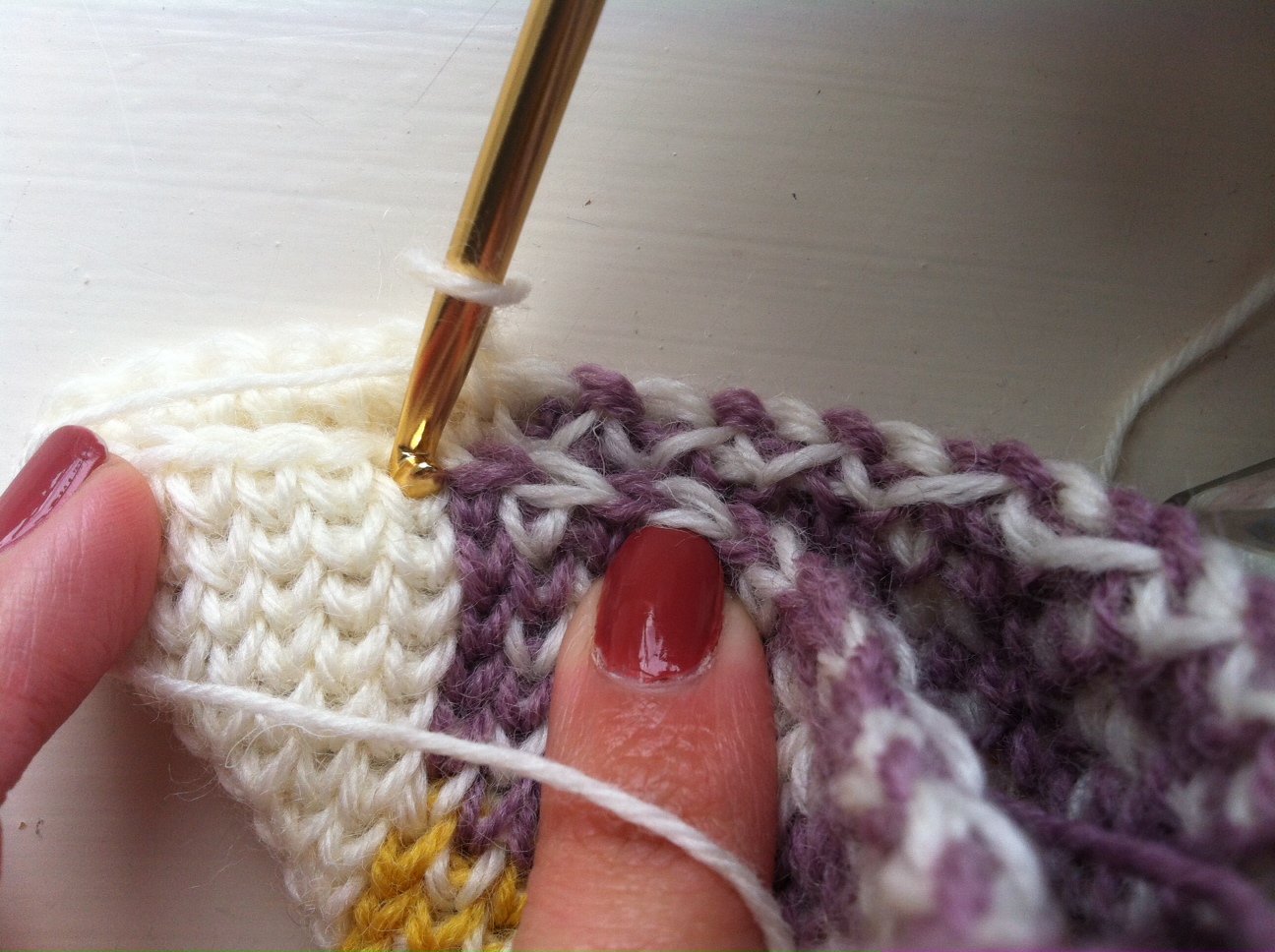
28. Now turn around and make a dc in the st that is closest to the first st of the round (the one I am pointing with my right thumb)…
51
52
53
29. Now simply join to first st of the round with a sl st and chain 1. You are ready for Round 46.
54
30. First st of Round 46 is white, followed by green. Continue with the round normally and for this round and all the rest forget about those 2 extra st we did on Round 45. So when you finish the fair isle chart for Round 46 with a green st…
59
31. Simply turn around and join with a slip st to the first st of the round, ch 1 and you are ready for the next.
60
61
32. And that is it everyone! Continue with the chart until Round 54 and fasten off. Weave in all the ends.
DSCN2538
Ufffff… I know, that was very long, hope it is useful and as usual please let me know if anything isn’t very clear.
Cheers!
x
Sol
Free pattern and tutorial: Autumn Diamonds – Part I

DSCN2533

*Ravelry link*

Hello there! As promised, I have taken some time to post my latest pattern because I wanted to make a tutorial for you guys. Since it was turning out to be quite a long tutorial I decided to post it in two parts, and here is the first one! I ended up taking the photos by myself so they are not perfect but I hope they are clear enough and I promise the next tutorial will be better.

DSCN2532

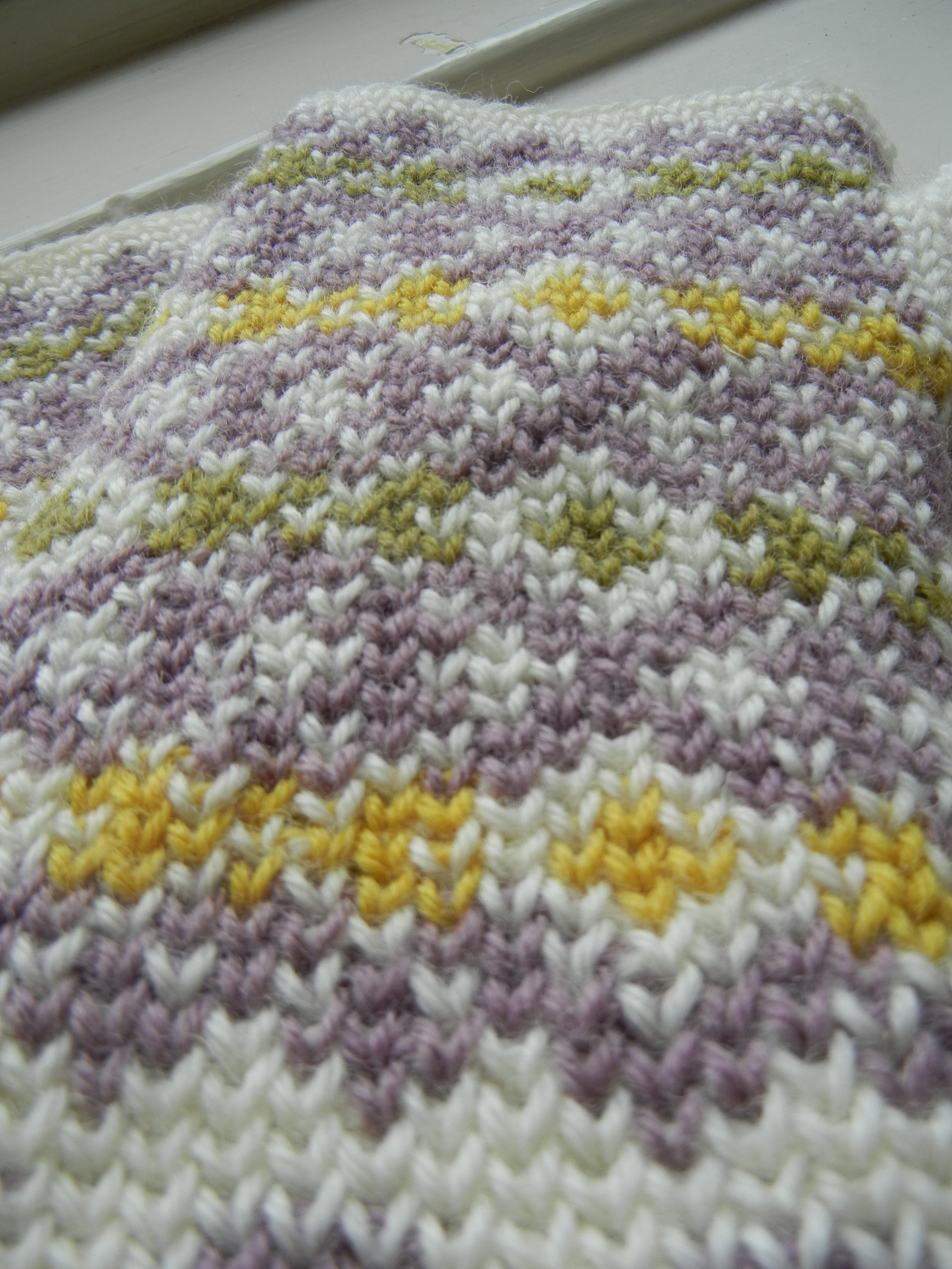
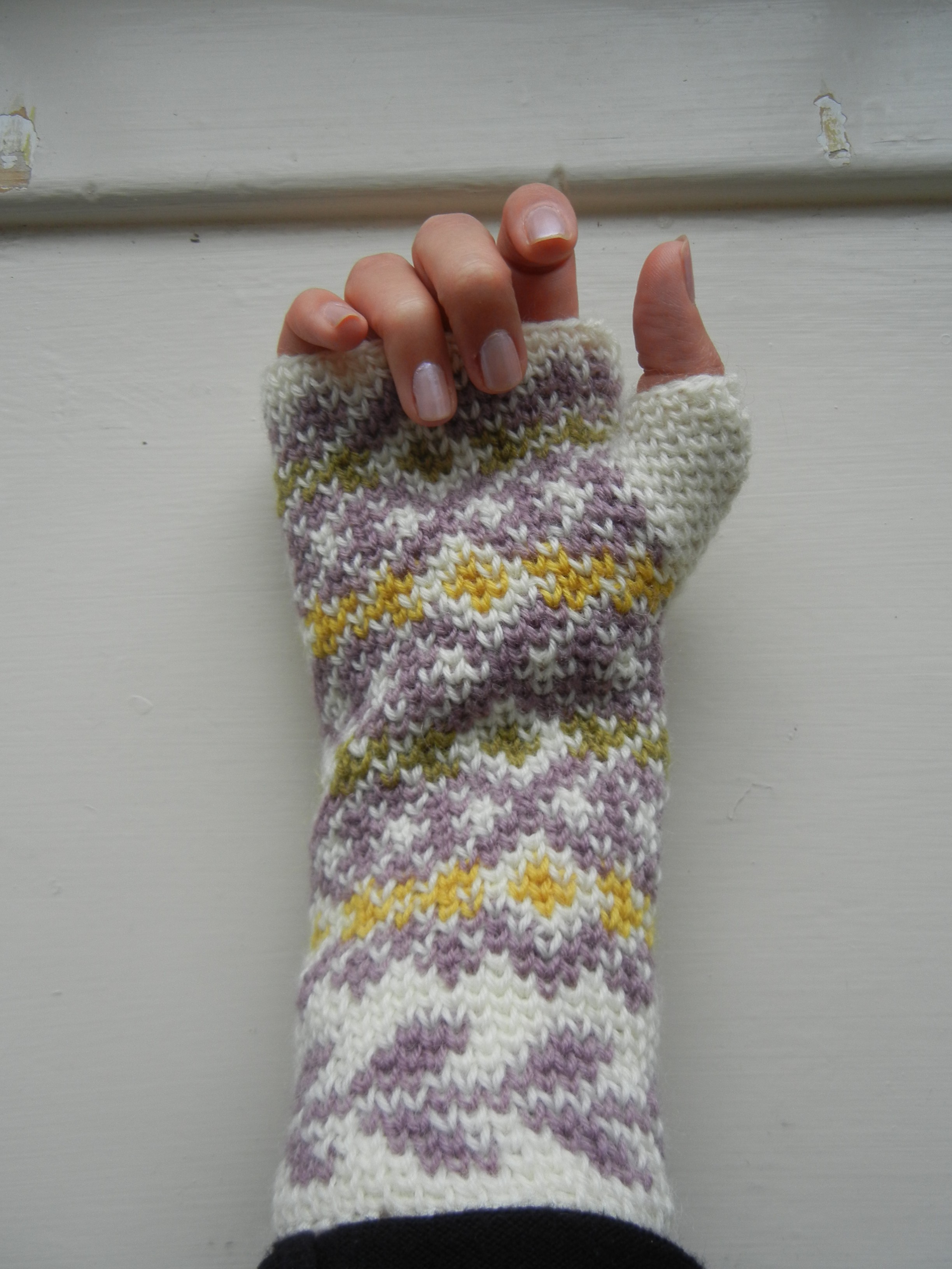
About the pattern, they are fingerless mittens with fair isle motifs using waistcoat stitch. I came across this stitch while looking in Google for ways to work fair isle patterns with crochet. I found a very nice and detailed explanation of the stitch here if you want more information, and it is a lot better than my tutorial 😛 The pattern is worked in the round and leaving the unused colour as strands in the back.

DSCN2535

The yarn is West Yorkshire Spinners in 4 ply and King Cole Merino. If you are in the Edinburgh area you can get it from Jess at Ginger Twist Studio. The pattern doesn’t use much yarn so you will have plenty left for another project and I already have something in mind for the leftovers so stay tuned!

This first part of the tutorial will take you up to right before the thumb, so you will have plenty to do before I post the second part.

 Autumn Diamonds Tutorial

Size and gauge

Circumference: 20 cm

Gauge: Crochet 11 waistcoat stitches and 13 rows with a 4mm hook to obtain 5cmx5cm.

Gauge in this pattern is not essential. Fair isle chart is repetitive and you can add necessary stitches for your size and fill in the pattern in a way that satisfies you. HOWEVER, PLEASE NOTE THE FABRIC MADE WITH THIS STITCH DOESN’T STRETCH, so please take that into account when deciding how many stitches to do.

Materials

50g King Cole Merino in Aran (Colour A)

West Yorkshire Spinners Signature 4 ply – 1 ball in Pennyroyal (Colour B), 1 ball in Butterscotch (Colour C), 1 ball in Cardamom (Colour D) –> You will use VERY little of the last two yarns so you could use something from your stash if you don’t want to spend  more on them.

4mm hook

Needle to weave in ends

2

Abbreviations

wst – waistcoat stitch

dc – UK double crochet

sl st – slip stitch

ch – chain

Instructions

We will be following the following chart for the first part of the pattern which will take you right before we start the thumb. You read it bottom-up, right to left, each row of the chart is actually a Round and each square is a wst. It starts from Round 3, first couple of rounds are simply two rounds using colour A (white). The tutorial will show you how to do the first few rounds so that you learn the technique and can apply it for the rest of the chart. It is the same pattern for both mittens.

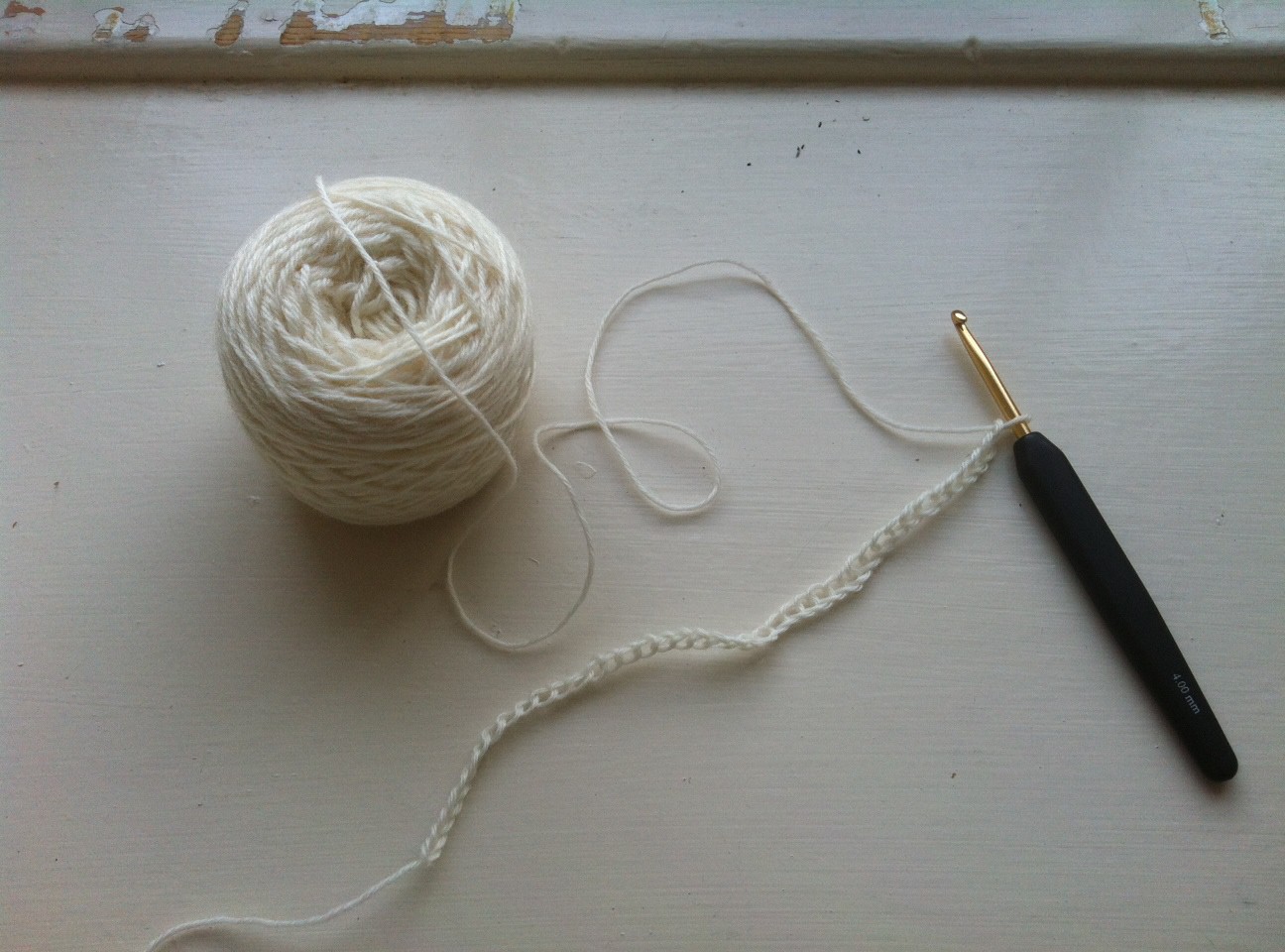
1. Foundation chain: With color A, chain 42

3

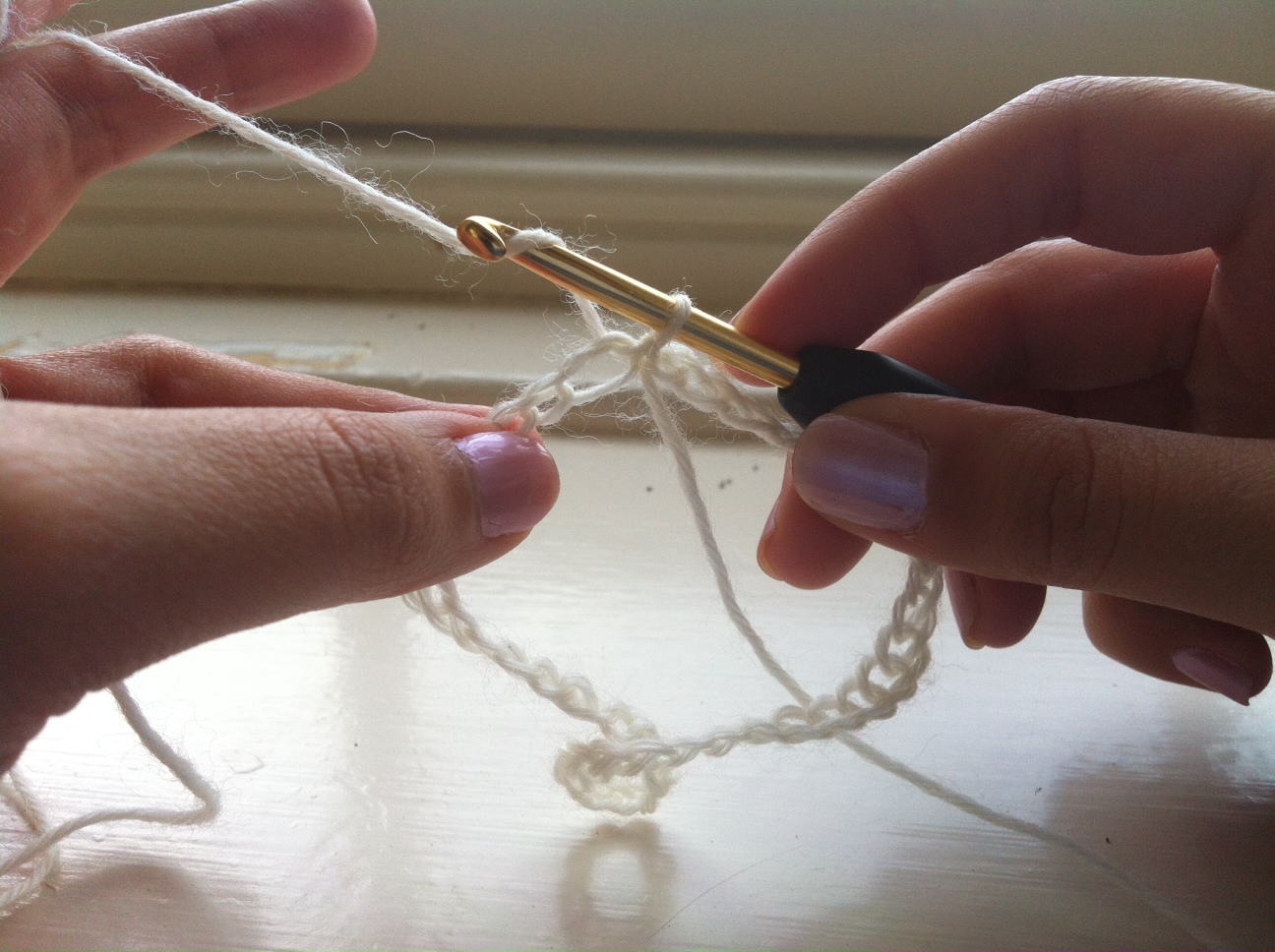
2. Making sure you don’t twist the chain, join the last chain to the first with a slip stitch

4

7

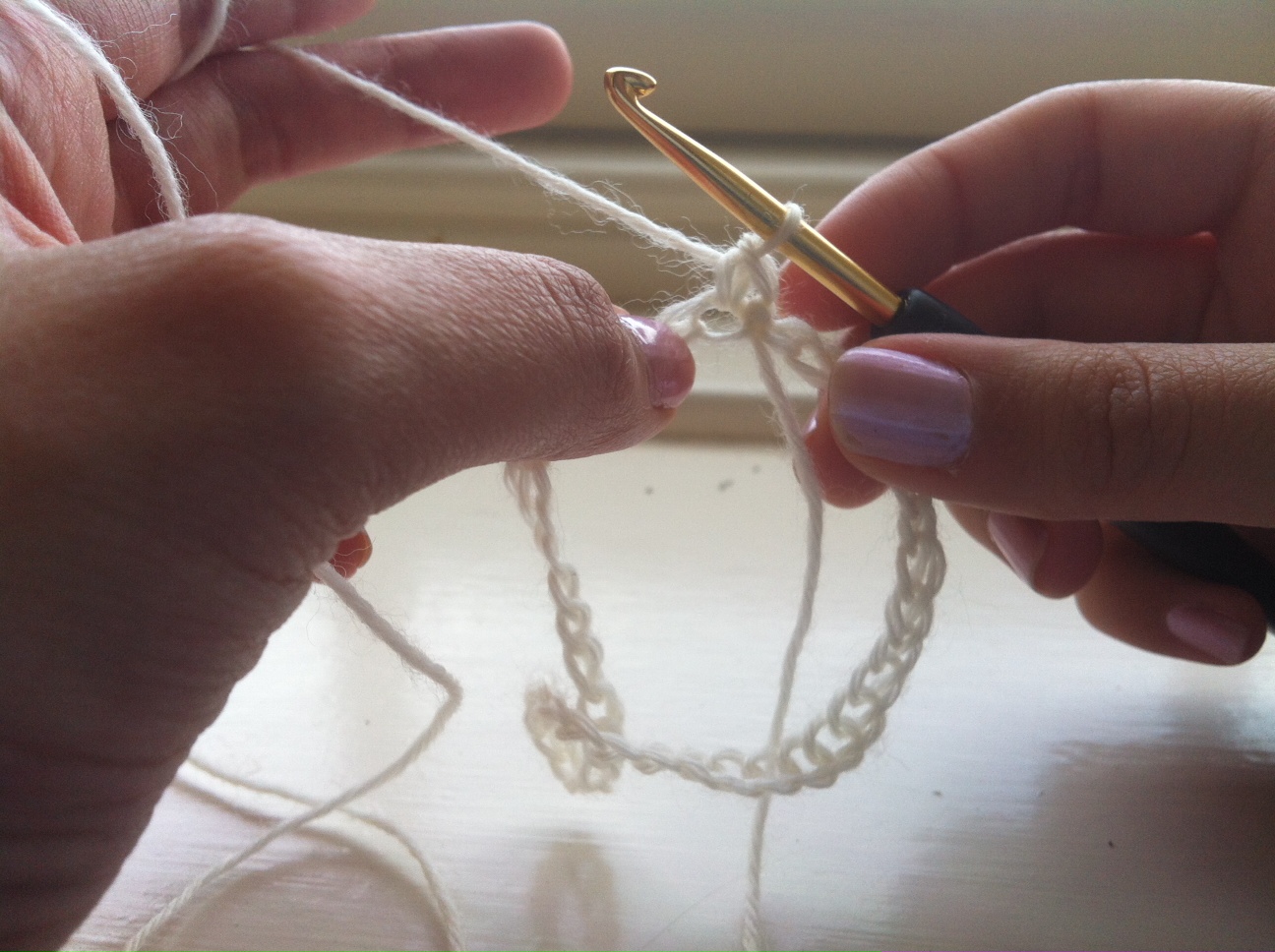
3. Pull on the yarn very tight to make the slip stitch as small as possible.

8

4. Chain 1, and then pull on the yarn tight again to make the chain as small as possible. These last two steps will be repeated for every round to make the seam less visible.

9

10

11

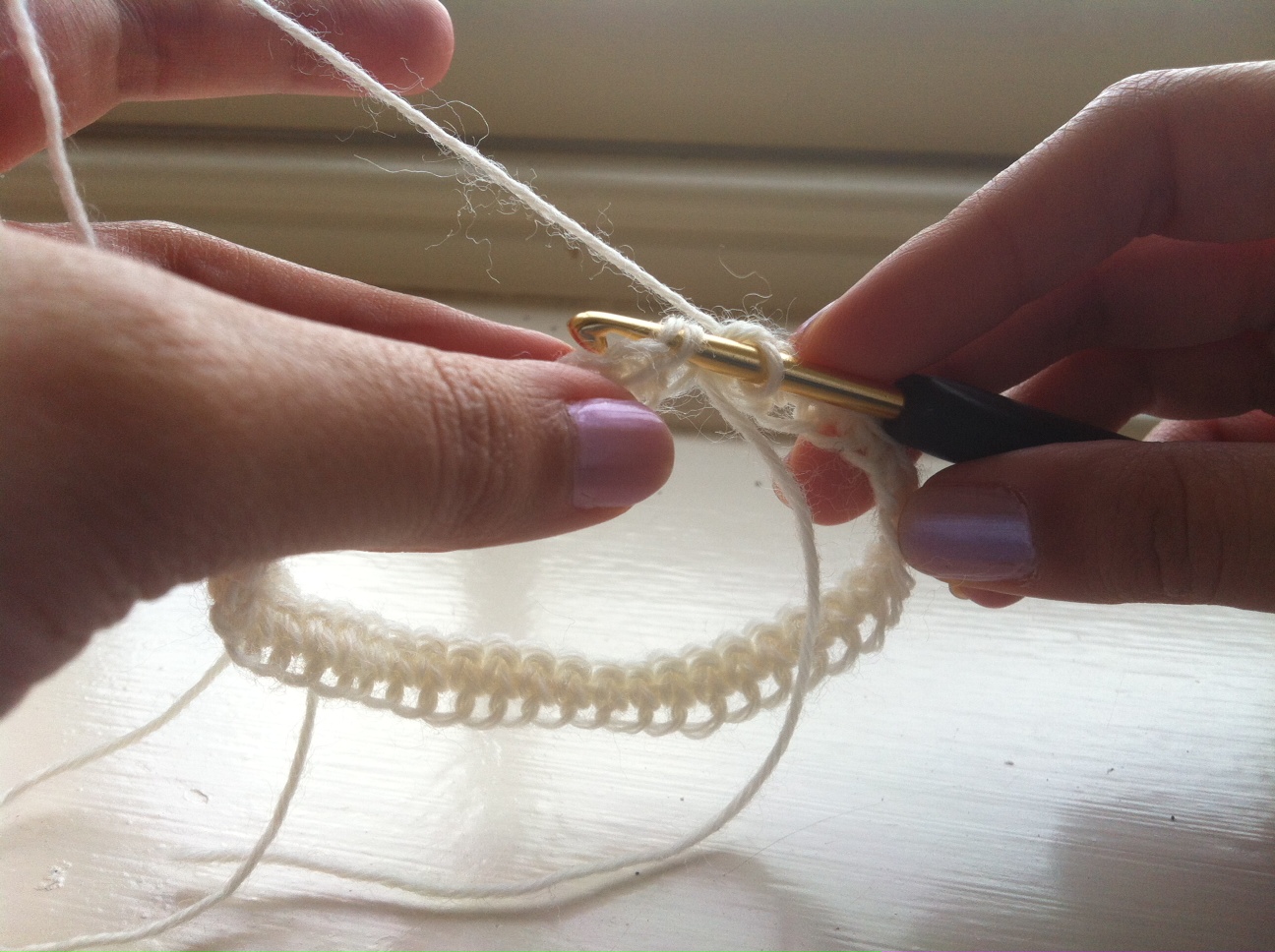
5. Round 1: Dc in first chain and every chain across. You need to crochet loosely all through the pattern to make it easier to do the waistcoat stitch.

14

15

6. Slip stitch to first dc, remember to pull tight. Chain 1 and pull tight again. *It was pointed out by someone trying this pattern that it might be easier to start with foundation double crochet rather than what I have showed here, so please feel free to try this out. Here is a tutorial of foundation double crochet.

16

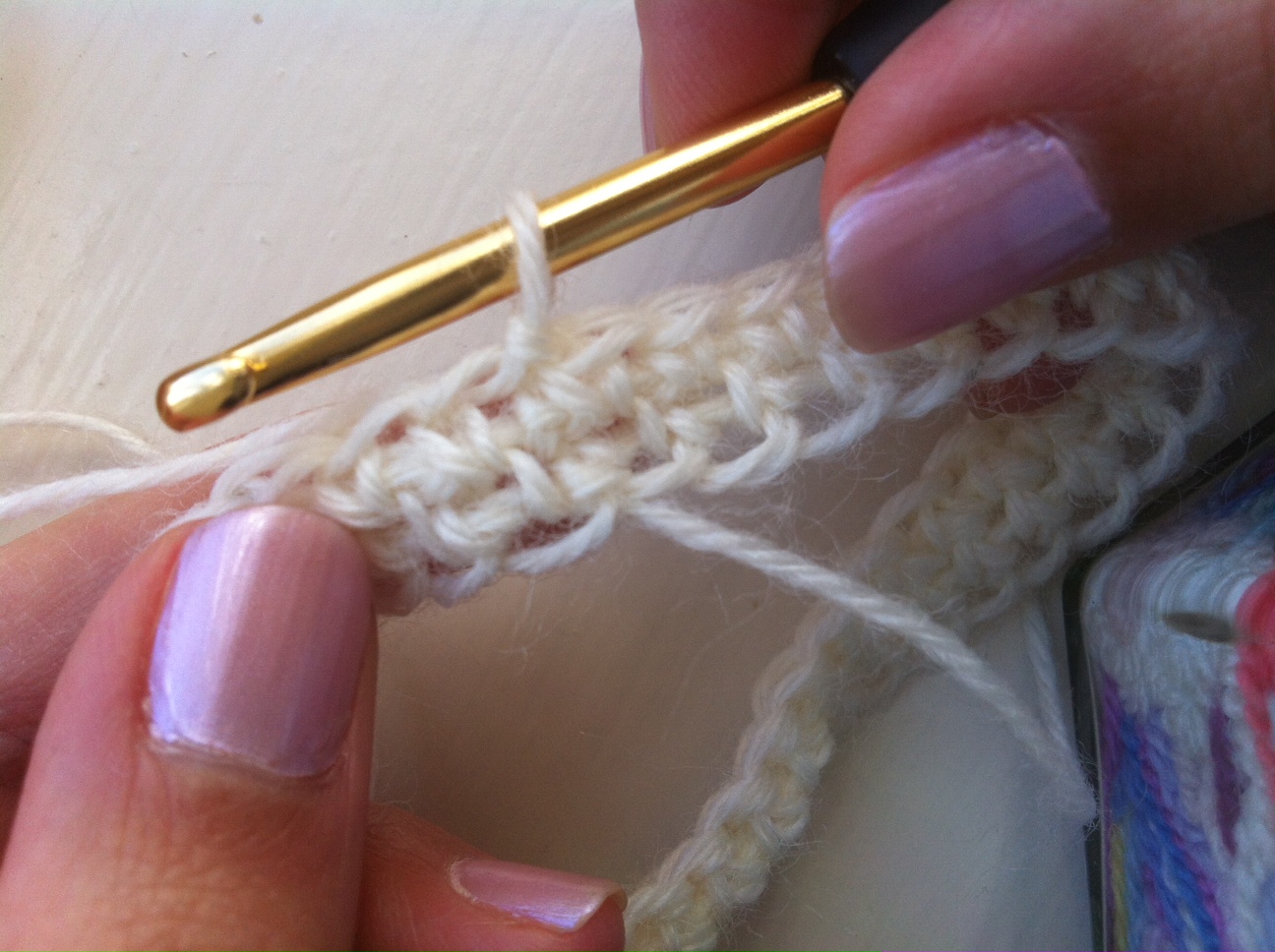
7. Round 2: On the first stitch, insert your hook in the post of the stitch, between the two strands that make the “V”. Yarn over and pull up a loop.


17
18
19
8. Yarn over and pull through two loops on hook. First wst done! (Here is a better tutorial for this stitch if it is still not clear)

20

9. Wst in next st and each st across.

21

22

23

24

24a

10. Slip st to first st, and chain 1. Remember to pull tight!

b

c

d

e

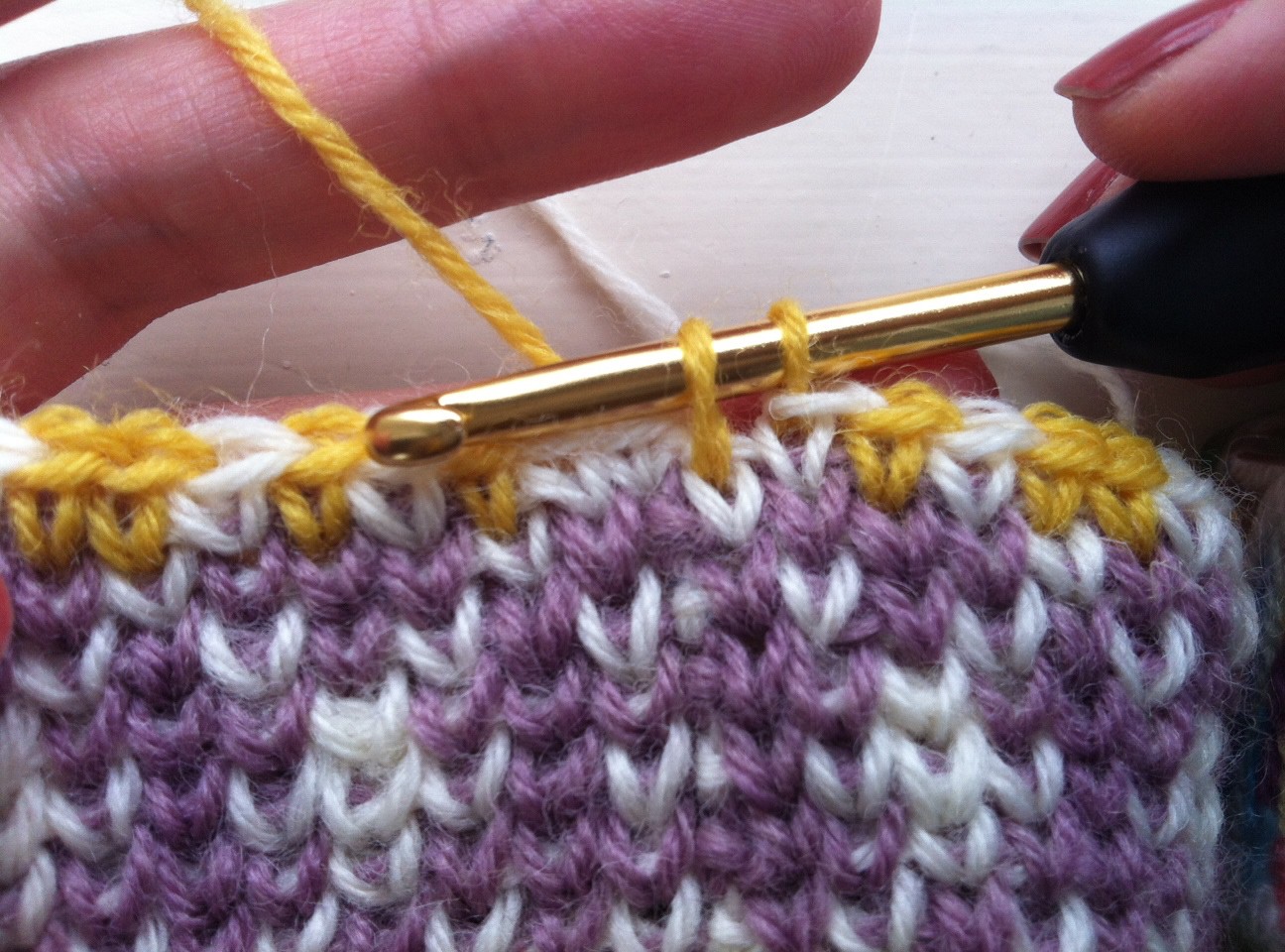
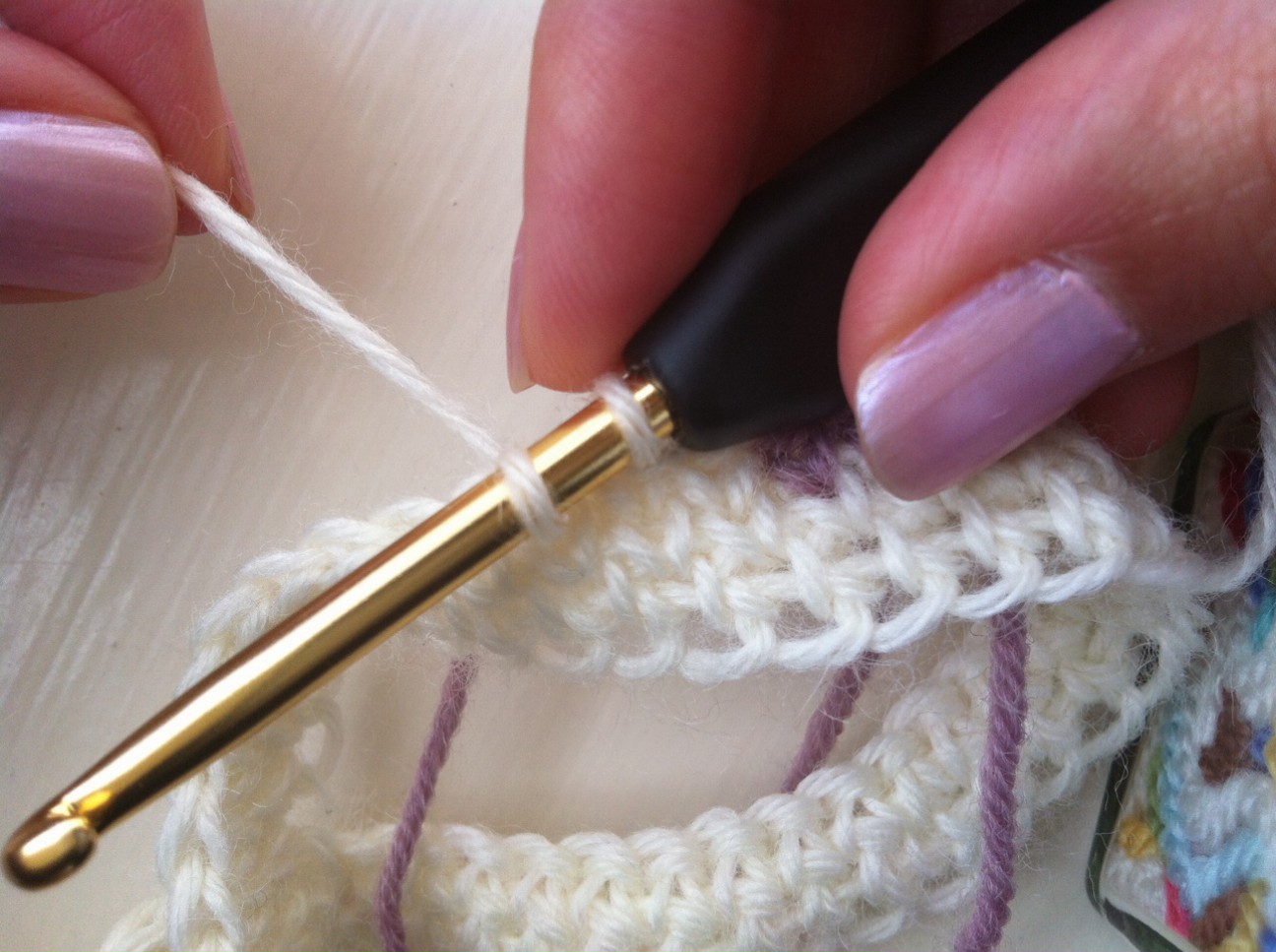
11. Round 3: We will introduce a new colour in the third round. The chart indicates that the first stitch is in colour A, and then you have 3 stitches in colour B. I will show you next how to make clean colour changes. Start your first wst: insert your hook inside the V, yarn over and pull up a loop.

24c

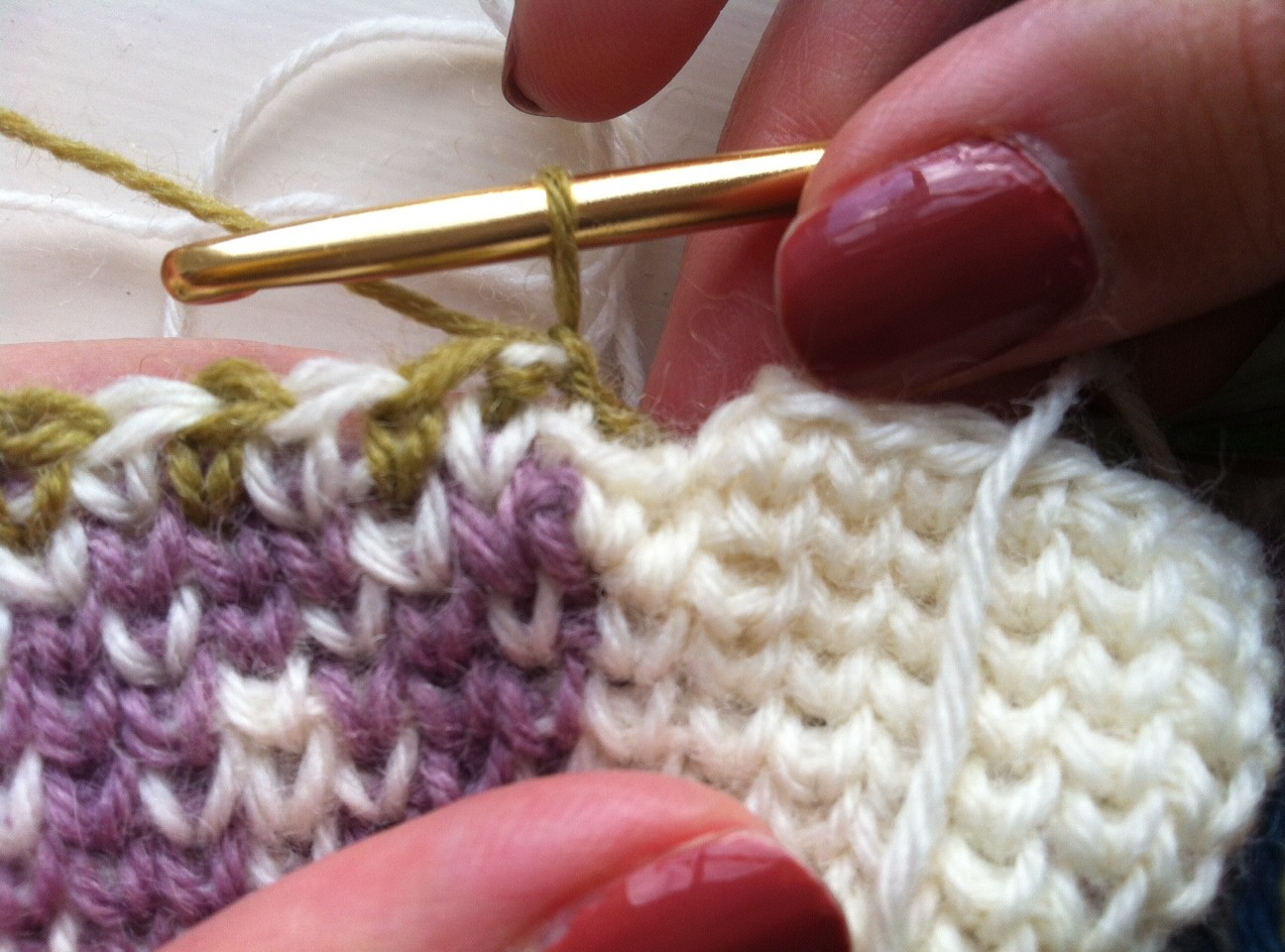
12. Here is when you need to change colours. Keeping your two loops on the hook, make a slip knot with colour B.

24d

25

13. Now finish the wst by pulling the new loop through the two you already had.

26

27

14. You just learned that you need to change colours in the last stitch of the previous colour. I will show you next how to not get your yarns tangled and get nice strands. Now the chart indicates we need 3 wst with colour B, then 3 in colour A and so on. So let’s do two stitches in colour B…

30

31

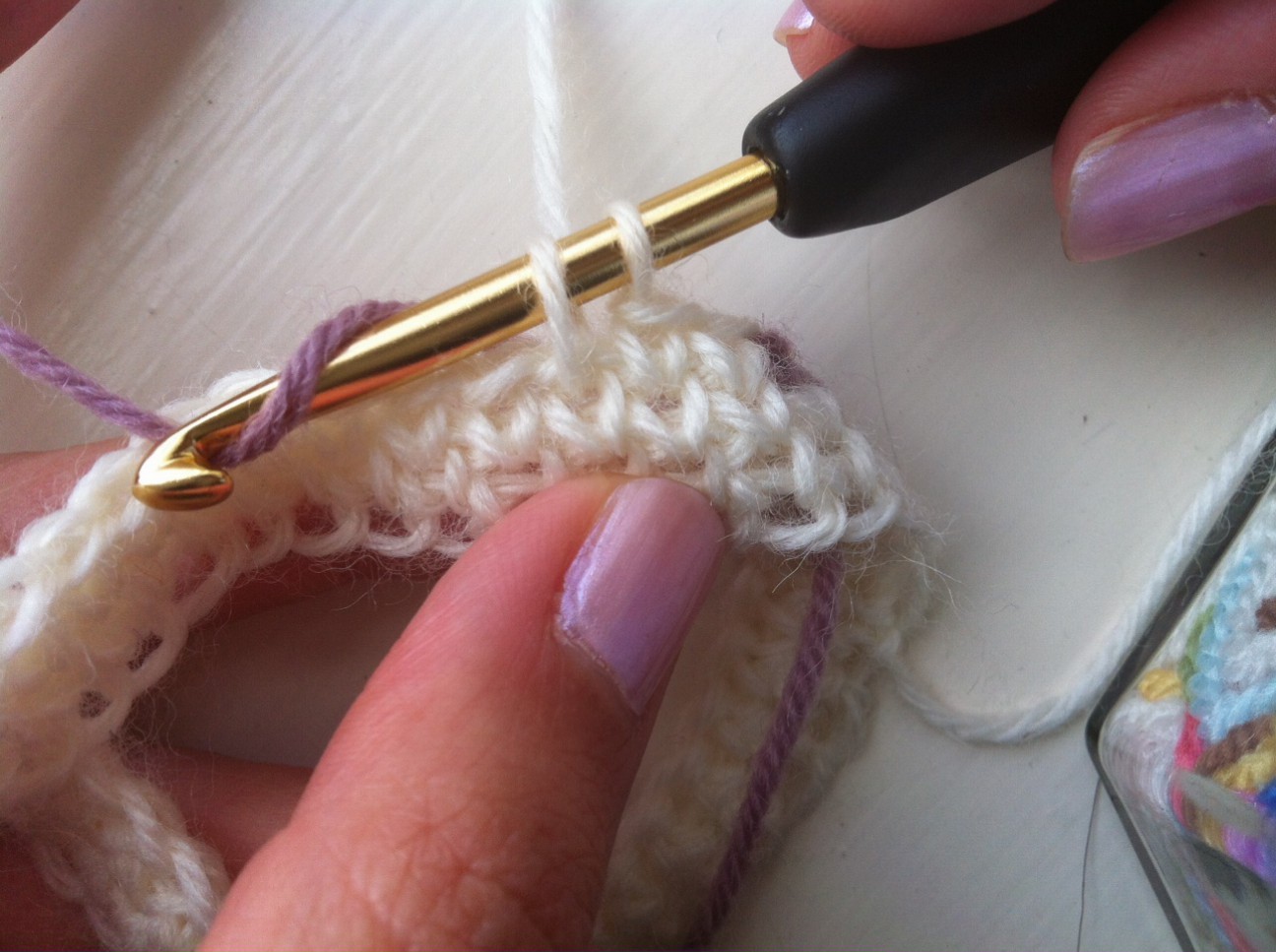
15. Start the third stitch up, insert hook in V, yarn over and pull up a loop. Now is time to organise your colours: put the white ball in front of you and the purple on the left. Make sure they are not tangled.

32

33

34

16. Drop colour B to your left, and grab colour A to finish the stitch. Pull colour A a bit to make sure that the last stitch you did on that colour is finished nicely. Then yarn over (don’t pull too tight so strand is not too tense) and pull through the two loops.

36

37

38

17. Now we need 3 white st, so we will repeat for the white: 2 stitches…

40

41

18. …and we change colour on the third. Insert hook inside the V, yarn over and pull up a loop. Now drop colour A and make sure you leave it in front of you.

42

43

19. Now grab colour B again on your left. You will notice that colour B comes under colour A. If you keep your yarns where they are and change colours this way they will never get tangled up and you will get clean strands. Yarn over colour B and pull through both loops on hook.

44

45

46

20. Your strands will look like this on the back. White ones will be higher and purple ones lower. Make sure that every time you pick up the new colour you pull on the yarn to make sure that the last stitch you made on that colour is finished nicely, but don’t yarn over with the new colour too tight or too loose so that the strands are not too tight that they will affect the tension or too loose that you might catch them too easily with something.

47

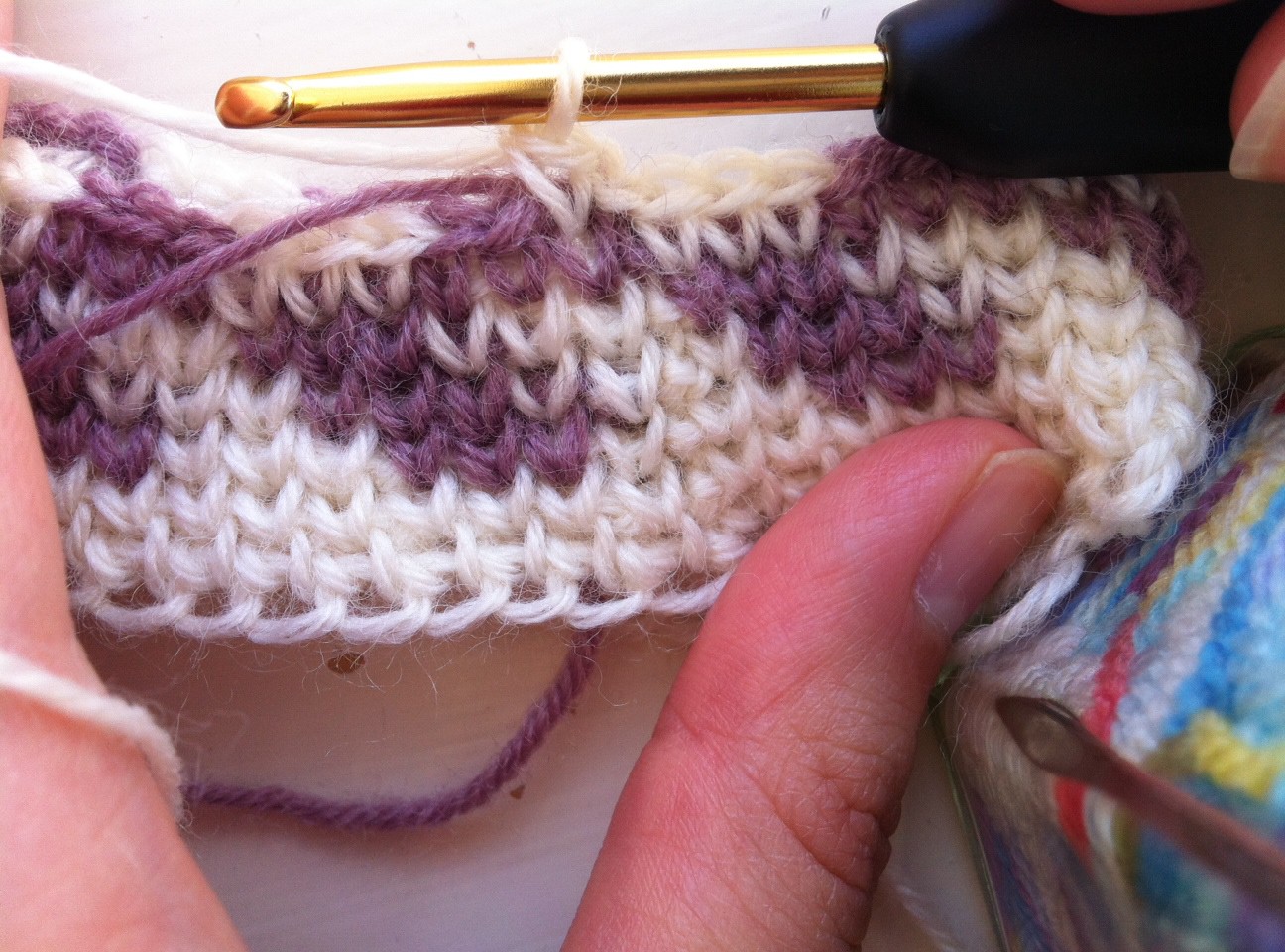
21. Continue with the chart until you finish the round. Slip stitch and chain 1, remember to pull tight. This is almost all the technique you need to continue with the chart. There only a couple of things left to show you: how to keep the length of your strands in check and what happens when you finish a round with one colour and have to start the next one with another. Let’s begin with the first one. Continue with the chart until the last stitch of Round 6, your mitten should look like this so far.

50

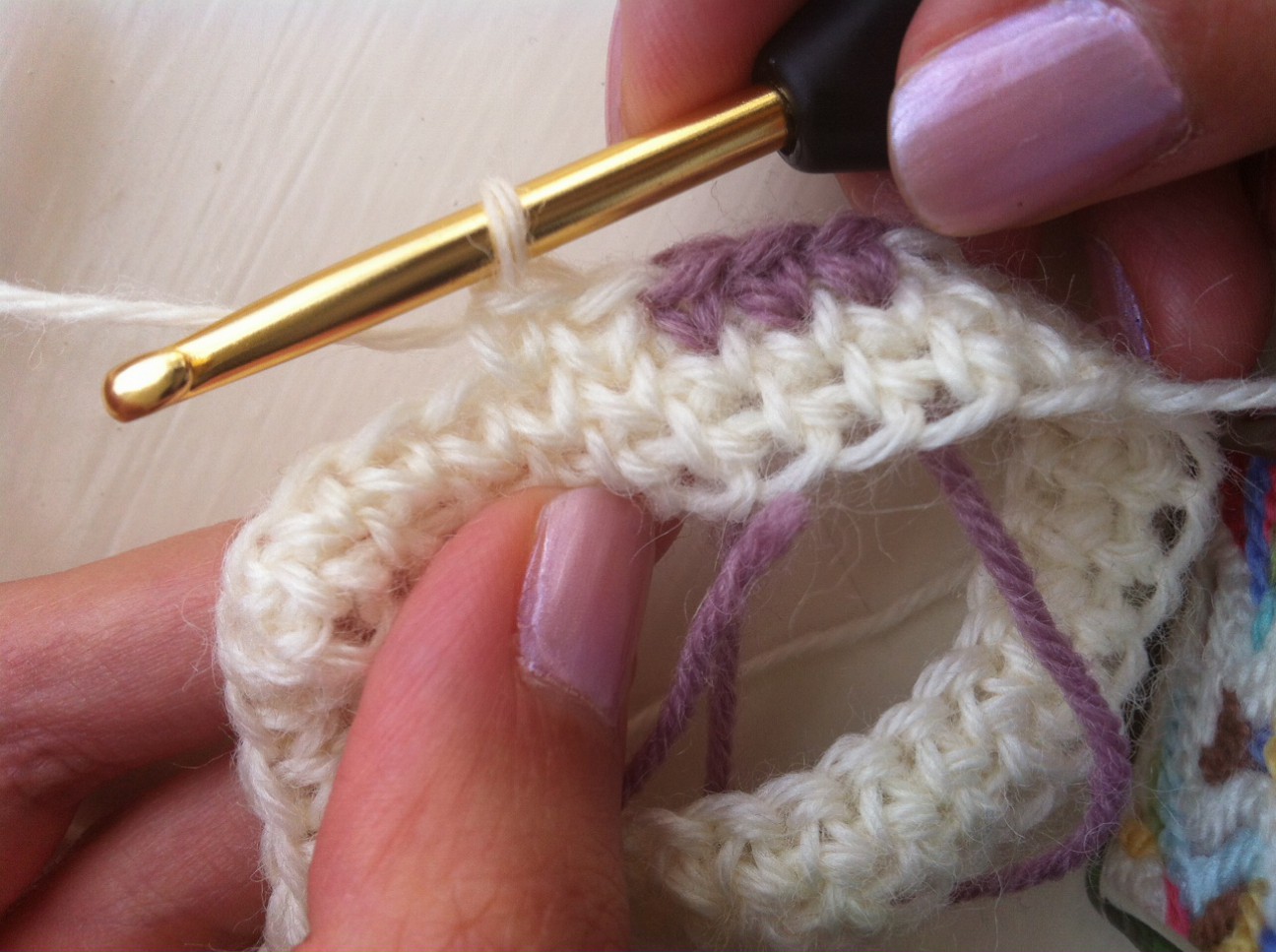
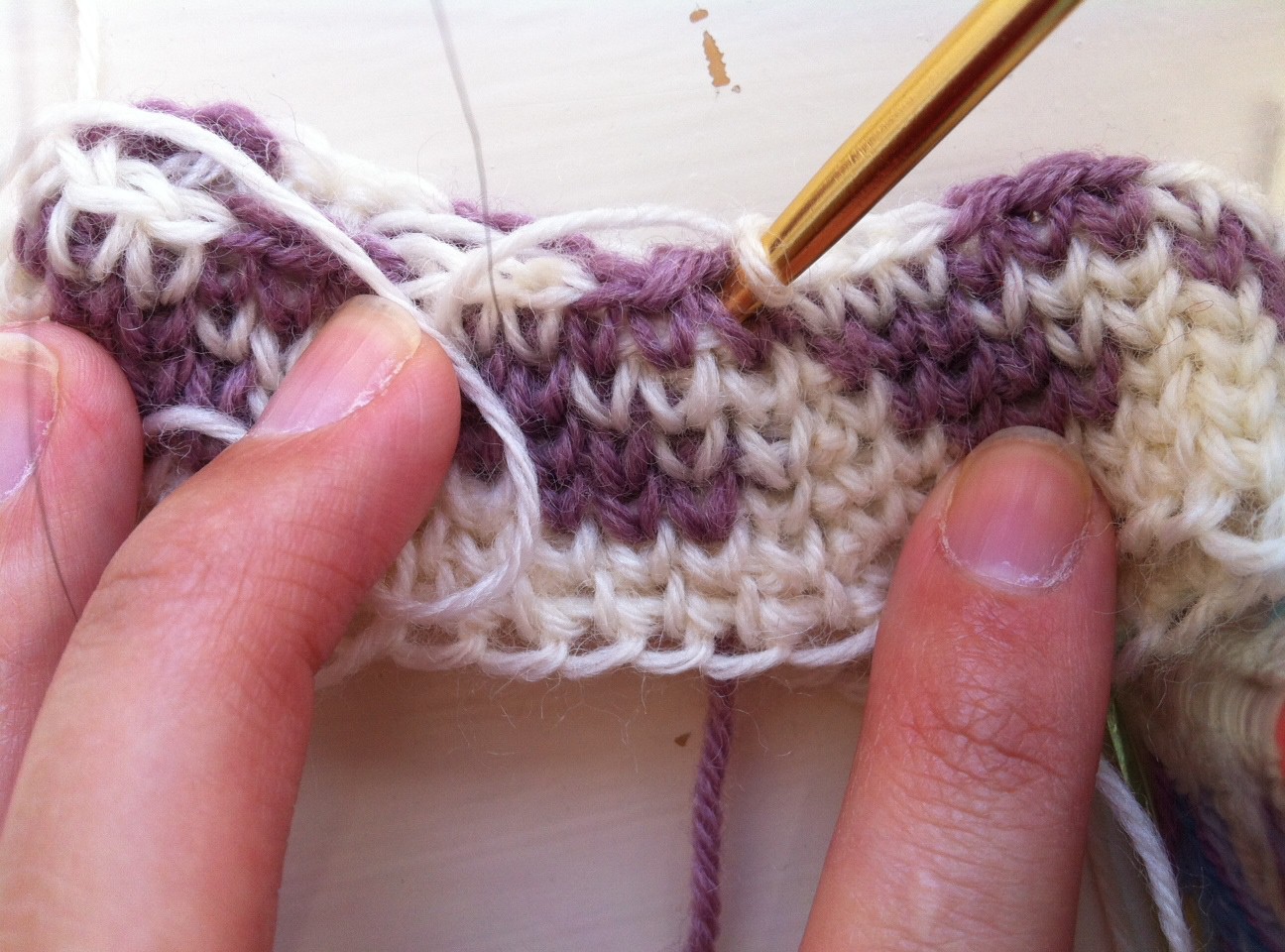
22. Here you will have to join and continue the next round in the same colour (white) for 3 more stitches. If you continue with the white as usual you will get a purple strand in the back that is 6 stitches long, I don’t usually let strands be longer than 3 stitches because they could get caught in something very easily so no matter how long a chart says I have to work with a specific colour, I always catch strands every 3 stitches. Let me show you how. First, join with a slip stitch to first stitch and chain one, pull tight as usual.

51

52

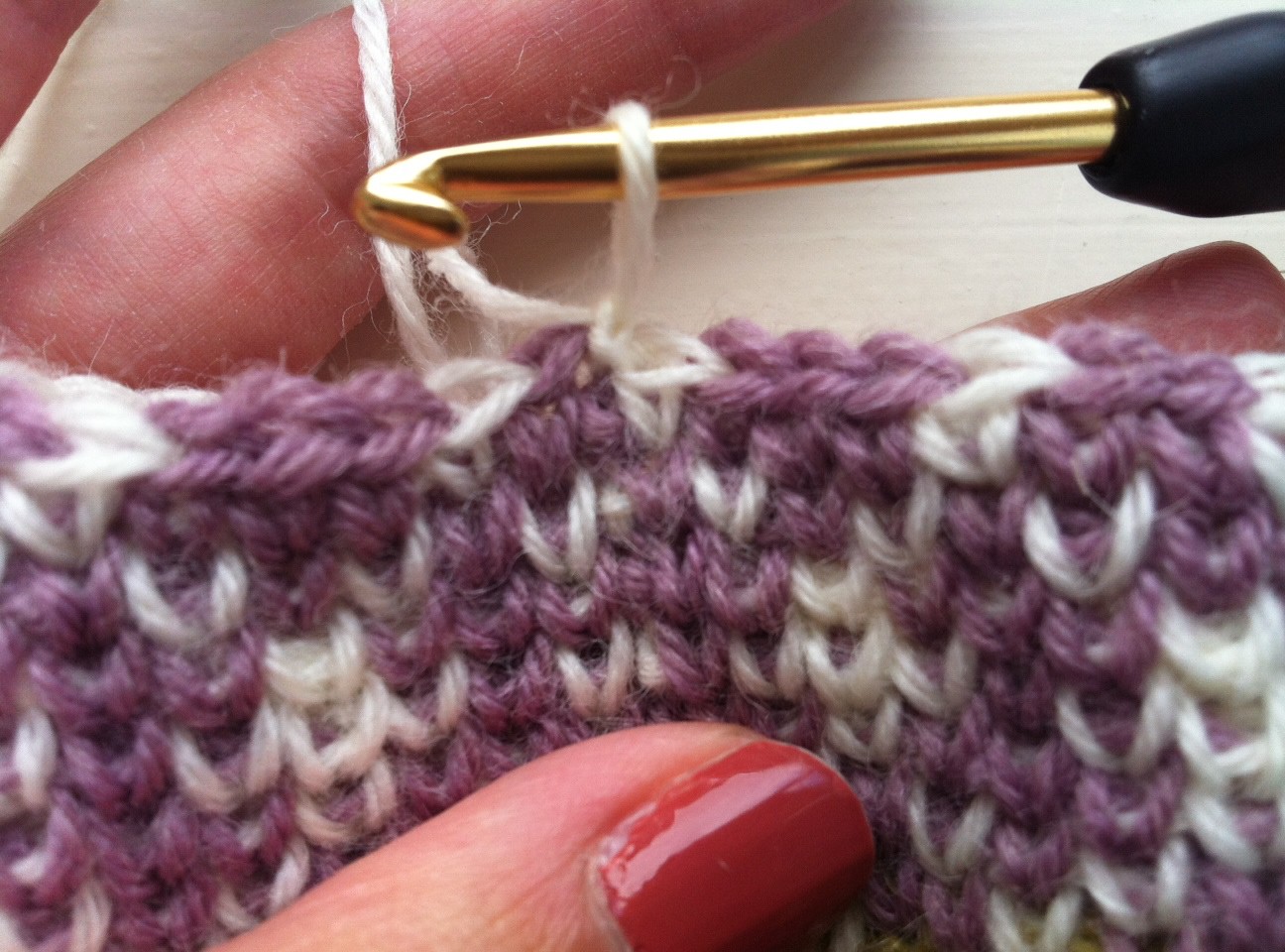
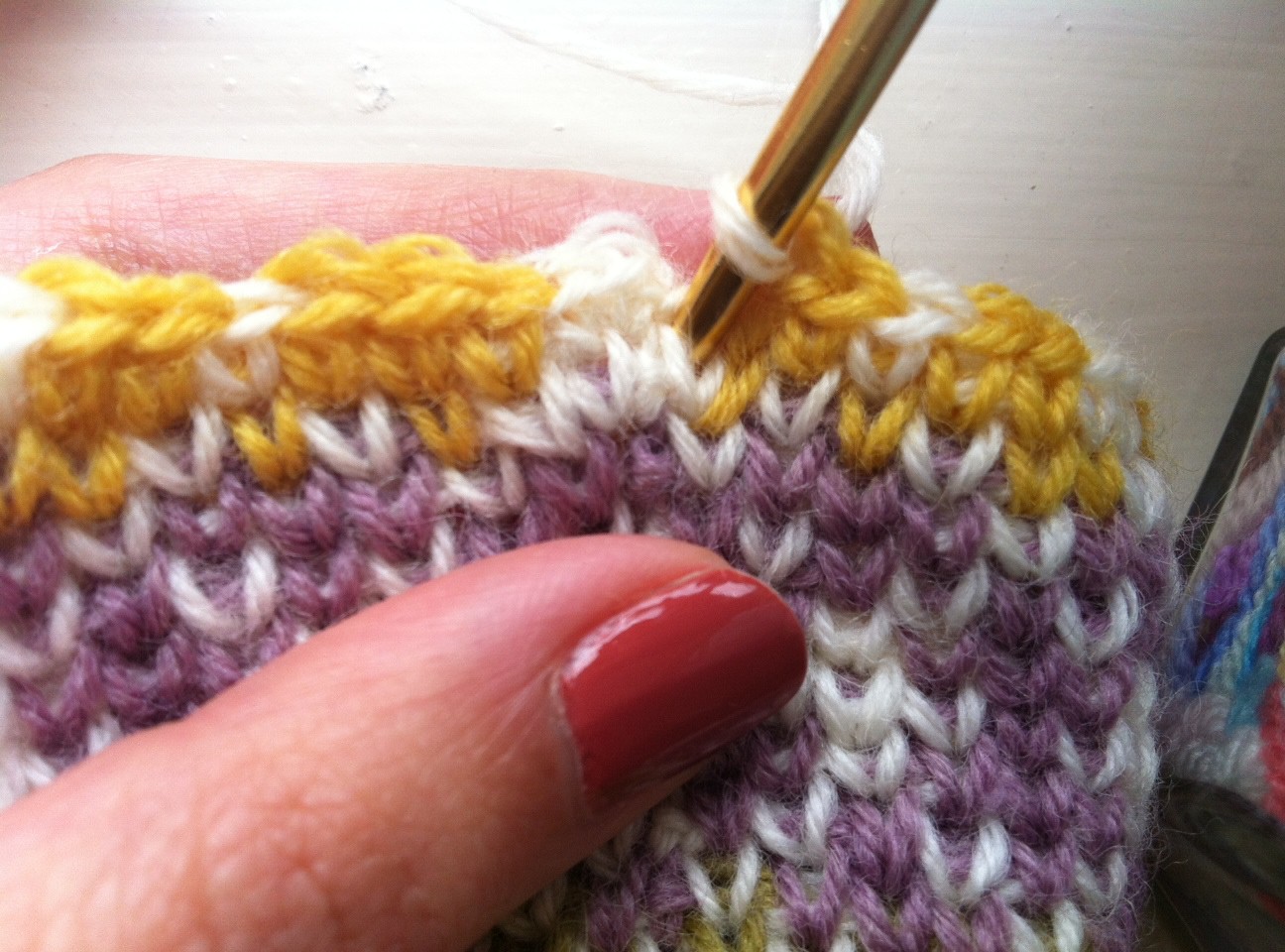
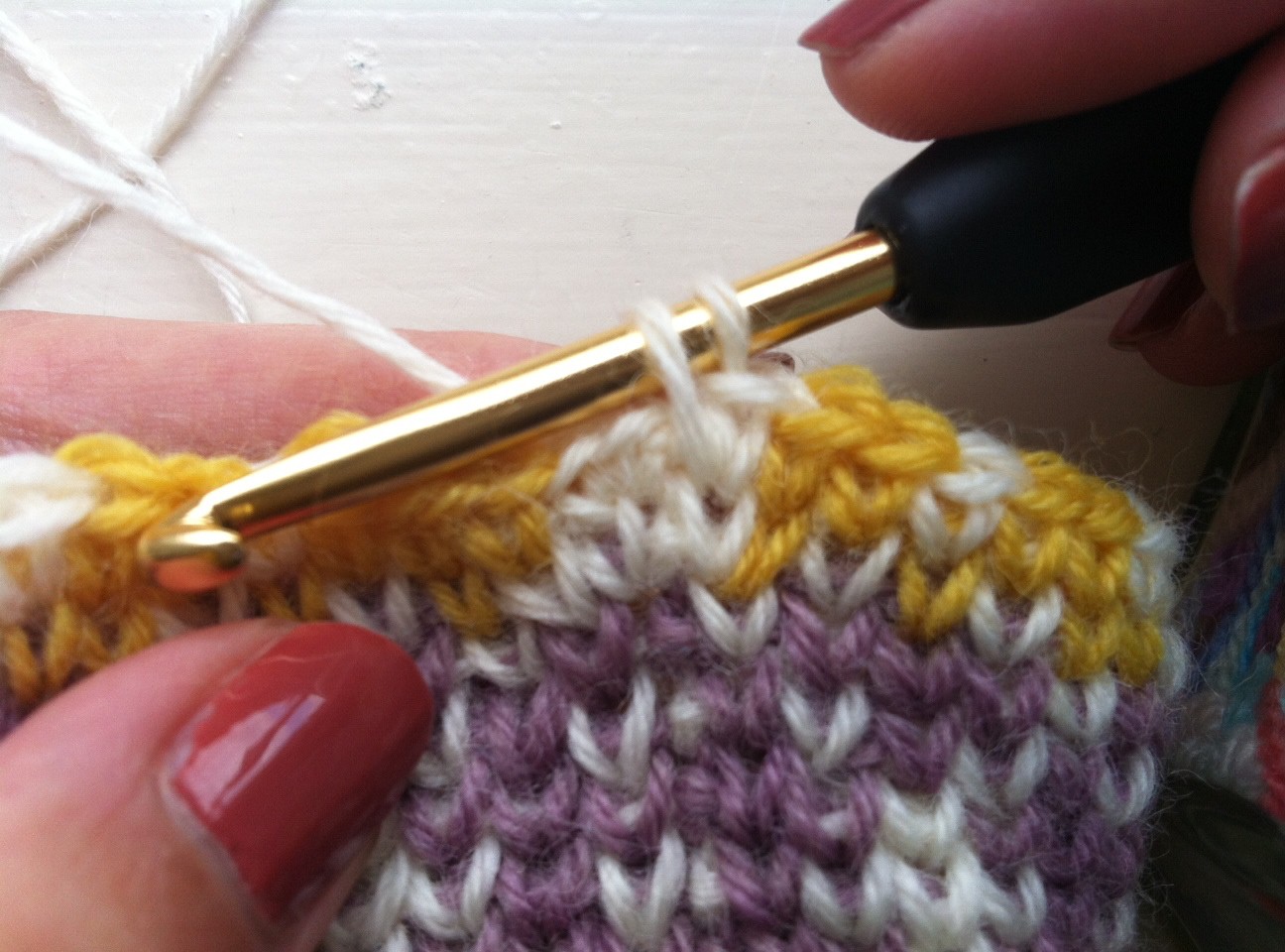
23. You have done 3 stitches in white in the last row (Round 6), so now it is time to catch the strand in the 4th stitch of the same colour, which in this case corresponds to the first stitch of Round 7. So start the stitch as usual by inserting the hook in the middle of the V (sorry about the hair in the way and my horrible nails!)

53

24. Now, before you yarn over with the white, make sure that the hook goes underneath the purple strand. Now yarn over with the white and finish the stitch as usual.

55

56

57
58

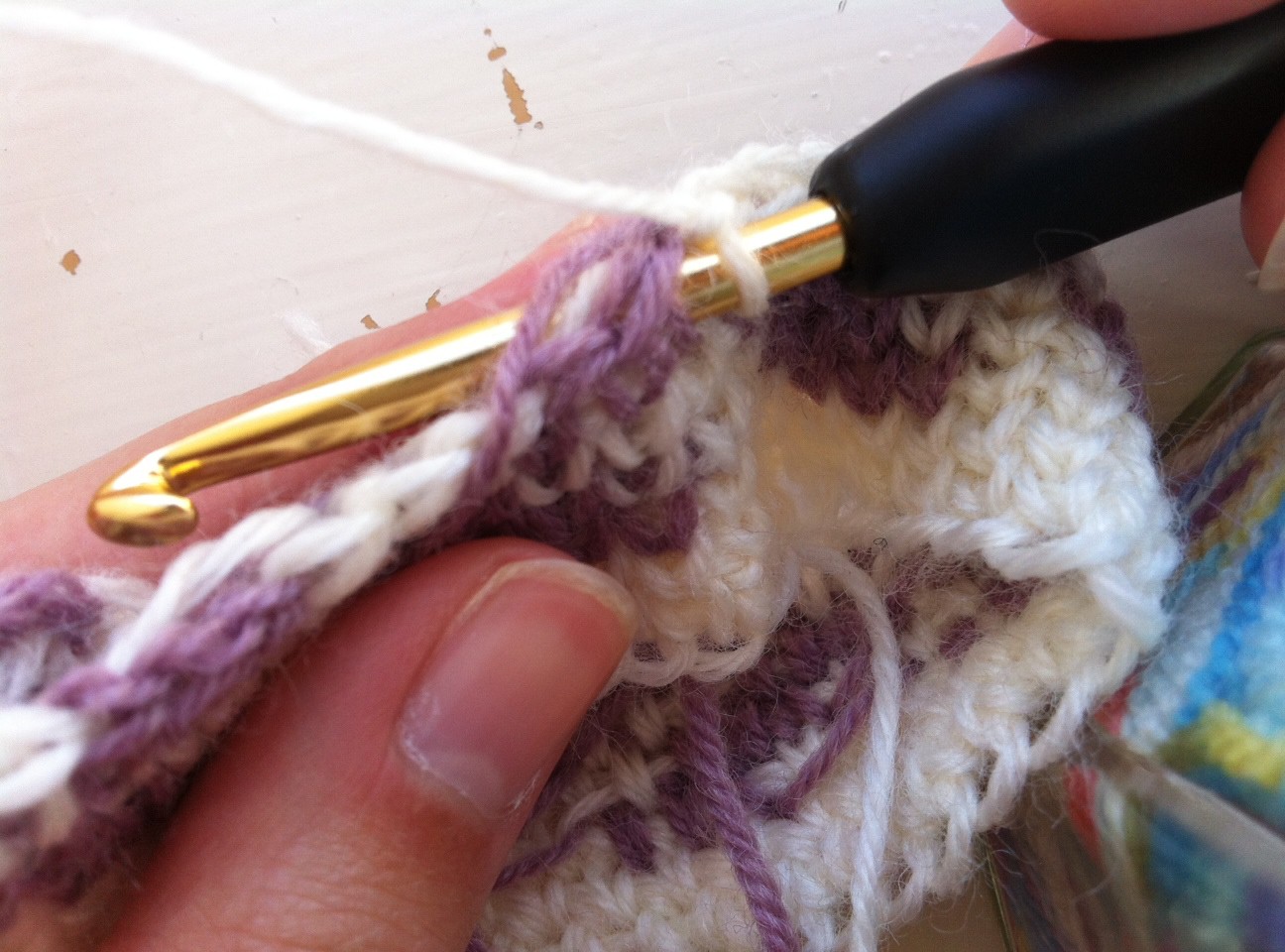
25. In the back, your caught strand will look like this. I JUST REALISED THIS HAPPENS FIRST WHEN YOU CHANGE FROM ROUND 5 TO 6! SORRY ABOUT THAT… make sure you catch your strand there as well.  

59

26. Continue with the chart normally. Now the final thing I wanted to make clear is how to change colours when you finish a round with one colour and start a new round with another. For example, this round finishes with colour B, and Round 8 starts with colour A.   So continue with Round 7 until the last stitch and just like with any other colour change, before you finish the last purple stitch of this round change to the white, then slip stitch, chain 1 and continue the chart with the white. I was going to put more pictures but it is really the same as before so hope it is clear enough, just let me know if you have any questions.

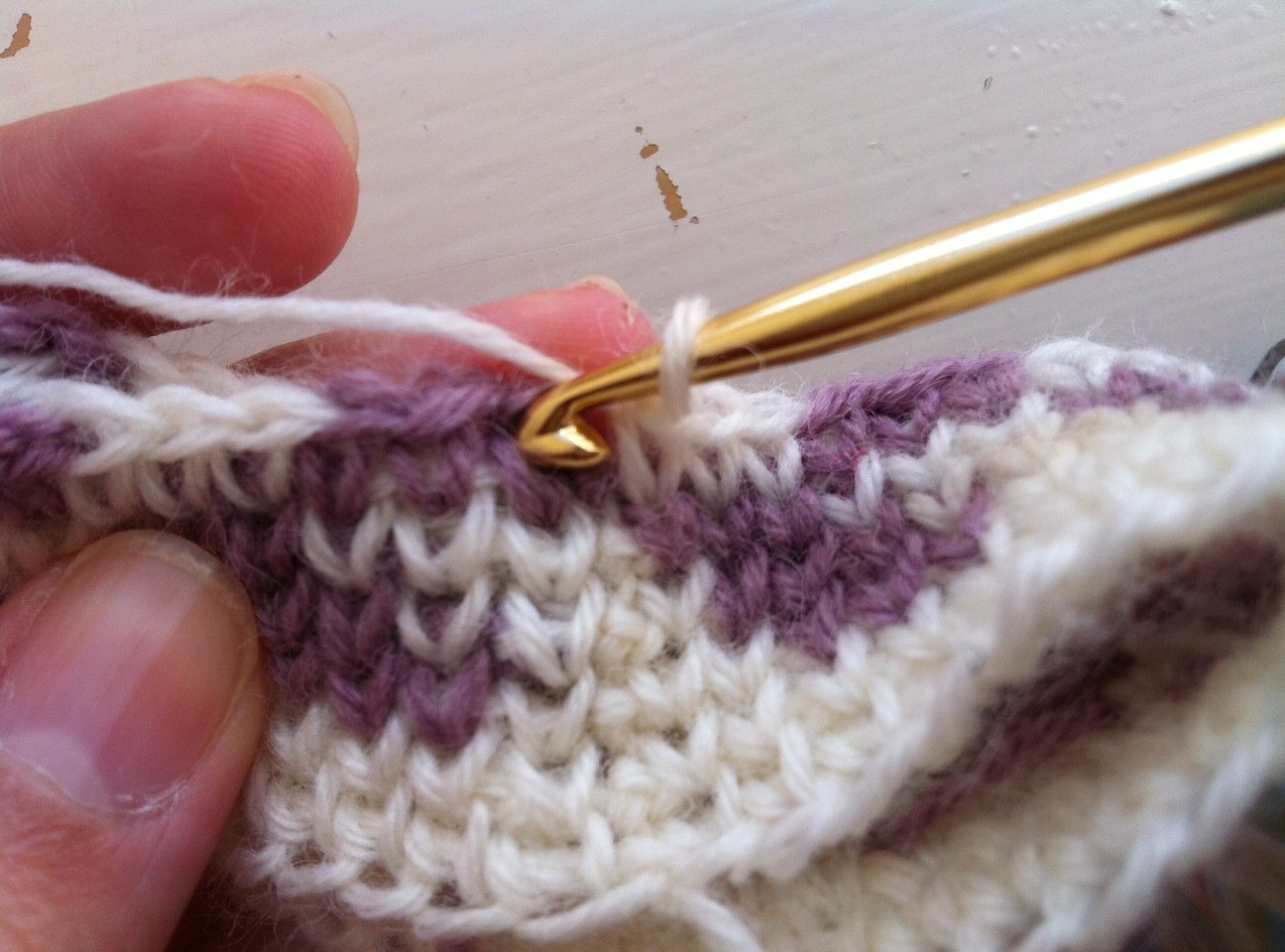
Continue with the chart until you finish Round 35. In case you are wondering about when to cut the yarns, I did it every time I finished with one. For example, the first few rows of the chart are white and purple, then two rows of white, white and purple again, then white and yellow and so on. When I finished with the colour that isn’t white and changed to another, I would cut the old colour. So I would cut the purple if the next 3 rows of the chart are white and yellow (hope this makes sense, it is quite late!)

Uffff, that was long! Please ask if you have any questions. I will post the next part of tutorial soon and have added the pattern to Ravelry too, here is the link.

Have a great weekend!

x

Sol

A new crochet world: Aoibhe Ni

Hello world! Hope you are all doing great and that weather where you are is nice and warm, very rainy in my part of the world today… Despite the weather, my very busy and difficult job, my very limited time for crocheting (or anything that is not working for that matter) and my tendency to get very low at times, I have to say I am feeling very happy today. I am very grateful for my life and those around me, even those that are far still fill my heart with joy and make me realise how lucky I am. Sorry for the cheesy intro but I thought I could share my joy with the world!

So I still haven’t done that photo tutorial I promised, I will give it a go tomorrow and see if I can do it by myself or if I will need someone else to hold the camera for me (Jess, if you are reading I am thinking of you!). I do have loads of pattern ideas in my head and I’m getting very frustrated that I don’t have the time to move forward with them, but that is life. I will get to them eventually and I guess you and I will both have to be patient! (I know, I hate it too…)

Since I didn’t want to leave you without a post this week I thought I would continue to share some of my inspiration and favourite designers with you. This time I would like to introduce you to the amazing Aoibhe Ni.

an9

an4
© http://www.halfadreamaway.com
an8
© http://www.halfadreamaway.com

If you like tunisian crochet you will fall in love with this designer. Her patterns definitely fall into the “I can’t believe that is crochet” category and her technique is very unique. She uses the tunisian crochet technique in a way that you can do it with a regular hook so that you don’t have to buy a special one just for her patterns. This is so smart, thoughtful and budget friendly that I couldn’t believe it was true. And not only that, she uses tunisian stitches in a way I had never seen before. 

an3
© http://www.halfadreamaway.com
an5
© http://www.halfadreamaway.com

With her designs you will learn tunisian crochet is more than simple stitch for cushions or scarves, oh, it is so much more! Her shawls in particular are STUNNING. I love that she uses lighter yarns and takes away that heavy feel that crochet is sometimes known for. Her designs are delicate, intricate and use lovely colours. Her yarn choice is usually expensive, but you can always substitute for something cheaper.

© www.halfadreamaway.com
© http://www.halfadreamaway.com

I have tried a few of her patterns and have loved them, sorry I don’t have more pictures but they were gifts so I don’t have them anymore.

de d

The only thing you need to be aware of is that since this is a different technique for tunisian it may take some time to get used to it. Her patterns are difficult to understand at first and she uses mostly charts instead of written instructions. The first time I followed one of her patterns it felt like Chinese, but then the second and third were a breeze. She has a free pattern called Pax, I found it more difficult than the other two I tried and would recommend to buy Phoenix instead as a first try if you can. If not, then some people have done some beautiful projects with Pax so please give it a try.

I am constantly in awe by how hook and yarn can give such a wide array of results and this designer is really stretching the boundaries. I am very thankful to such people and hope that you will be too. Stay tuned for the tutorial!

Happy weekend!

x

Sol


A new crochet world: Kat Goldin

Slugs on the Refrigerator

Hello everyone! I assume you are as happy as I am that tomorrow is finally Friday (yay!). I have been so busy lately that weekends seem to come rather quickly and they are gone even quicker. I had some time today so I thought I would start to talk a bit about my inspiration and how this crochet journey began. I will write a series of posts highlighting designers and patterns that I like or have tried and hopefully it will help when you are looking for some inspiration yourselves or just some really nice pattern to try.

Before I jump to it, I wanted to give you an update on the fair isle pattern I have been working on: both mittens are done and I was going to start writing the pattern when I realised that a photo tutorial would be very useful for some parts that might be confusing with just written instructions. So, I have decided to take a bit longer and do a proper tutorial for you guys, hope it is worth the wait! Have never taken photographs of me crocheting, I am predicting it will be quite interesting…!

Back on subject, let me tell you a bit about my crochet journey. I learned to crochet when I was around 10 years old and have been crocheting on and off ever since. A few years ago I started to find some free patterns online and was drawn back into crochet once again, but it wasn’t until around 2 years ago that there was a real change in the way I saw crochet.

As it happens, some friends were having a baby and I decided to crochet something as a gift. I was already living in Edinburgh and I went to the library to find some books when I came across Kat Goldin’s book “Crochet at Play”. I have crocheted many baby items, but for the first time in my “crochet experience” I was seeing something different, something I hadn’t seen before. Fun and different patterns that weren’t the typical light pink or blue baby blanket or the white cardigan with matching hat. Those patterns are lovely, but I have seen them MANY times before.


k4


k1

“Crochet at Play” has slippers with claws, hedgehog mittens, wolf cardigans, fox scarves, octopus pillows and much more. For the first time in my crochet experience I was seeing fresh, interesting, inspiring patterns. I think that is one of the reasons why I had left crochet aside: patterns didn’t have attractive colours, didn’t look wearable or practical, sometimes they looked outdated. I am not sure of the timing when patterns like these caught my eye, maybe they have been around for a while but it was my first encounter and that really kicked off this crochet journey.

Slugs on the Refrigerator

I really recommend Kat’s book, she is great if you have any questions (talking from experience!) and she has some other beautiful patterns that, as her book, are different. She has designed modern and wearable garments and accessories, with lovely colour combos and fibres (check her website here). She has become one of my favourite designers and can’t wait for her new book coming out in September.

Maybe the knitting/crochet boom has helped, maybe the beautiful new yarns available online to every part of the world has contributed as well. I often go on Ravelry and there are so many lovely patterns, but only some of them catch my eye: those that use techniques I haven’t seen before, or different stitches, or combine colours differently. The ones that I think: “I have never seen that in crochet” or “That doesn’t even look like crochet!”. This has driven my own creative process for my patterns: I am trying to design things I haven’t seen before. I think granny shawls are lovely, but I won’t make a pattern for one when there are so many around and when I know more talented people can get more beautiful colour combos than me. I want to try new things, challenge myself and make my small contribution to this new crochet world, one with endless colourful opportunities.

Have a great Friday 😉

x

Sol

A journey update

m1

Hello everyone! Hope you had a great week. I mentioned in my last post I started a new job and it has taken over my life recently, as with any big change I am trying to juggle things around and unfortunately crochet time has been reduced. This means that patterns may not come as often, but they will come! I will continue to post crochet goodness and share my projects and patterns with you and I hope you stick with me during this transition process. I want to share more of my inspiration, patterns and yarns that are catching my eye so expect some of that soon.

m2

In the meantime I thought I would update you on that thumb problem of mine… and tell you that I got it! The first fingerless mitten is done and the thumb has been mastered at last. I am so happy with this pattern and want to share it with you guys as soon as possible but first I need to get the other one done so that I can take some more pictures for you. This way of doing fair isle is my favourite I have to admit, it takes longer but the patterns are clear and they don’t distort.

m3

I think this pattern will be a milestone in my crochet journey and I am so happy with the discoveries and new places this process has taken me. I already feel more confident when approaching a pattern idea and I think the knots in me are loosening bit by bit. I think I can even see colours a bit more clearly! And a big part of this nice and happy feeling inside me is because of all of you: visiting my blog, liking my patterns on Ravelry, pinning them on Pinterest or leaving a nice comment. So I just want to say a big THANK YOU for being a part of my crochet journey and cheering me up all the way. Means the world!

Hope you have a great weekend with loads of time to crochet 😀

x

Sol


Free Pattern: Happy Triangles – BLO version

tt2

*Ravelry link*

Happy Friday everyone! It has been a very busy week for me, I started a new job and it has brought many challenges and has occupied most of my time so I hadn’t had the chance to share the second version of my last pattern with you.

My Happy Triangles pattern published recently used UK double crochet and a 3mm hook for a DK weight yarn, which gave a very tight and dense result. I wanted to share with you the version of this pattern using UK double crochet in the back loop only (BLO) and a slightly bigger hook.

So the first obvious result with this changes is that you get a bigger purse for the same number of stitches: 22.5cm long instead of 20cm. I made this purse a bit shorter to get a more rectangular shape, so with 6 rows of triangles you get a 22.5cmx14cm purse.

Secondly, the BLO makes the triangles look straight and since the colours are not contrasting they look sharp as well. The seam technique I mentioned in the pattern works great with BLO so you get a very straight seam, in the original pattern it twists up a bit so that it shows on one side of the purse. It doesn’t bother me but if you prefer a straight seam then BLO is the option. Finally, using BLO gives a different texture to the fabric than the one you get doing the stitch normally, you get ribbed rows that I believe look quite nice.

tt4

So if you prefer this version of the Happy Triangles pattern, here are the instructions! I made a slight change to the base so that the seam runs along the side and doesn’t show.

Happy Triangles Pattern – BLO version

Size: 22.5cm x 14cm

Materials

Rico Design Essentials Cotton DK: 1x50g ball White, 1x50g ball Blue Green, 1x50g ball Pistachio

3.50mm hook

Fabric for lining ( I bought 20cm of a fabric and it was enough)

Needle

Pins

30cm zip

Abbreviations

dc – UK double crochet

sl st – slip stitch

ch – chain

htr – UK half treble

BLO – back loop only

tt1

Instructions

Base: With white yarn Ch 50, 2htr in 3rd ch from hook, htr in each st across until last ch, 6 tr in last ch. Turn to work on other side of ch, htr in next ch and each ch across until last ch, 4htr in last ch, sl st to first htr (104 st). Don’t turn.

*Remember to pull tight on the sl st and the ch 1 when starting a new round to keep the seam straight.

Round 1: Ch 1, dc in BLO in each st across until the end, sl st to first dc (104 st). Don’t turn.

Round 2: Ch 1, dc in BLO in next st and each st across until the end, sl st to first dc. Don’t turn.

Round 3-26: Follow chart below, from bottom-up and from right to left. Each round has 104 st (each square is a st) so you need to repeat the 8 stitches in the chart 13 times for each round (13×8=104). Remember to continue working each dc in the BLO. Repeat the chart until you have 34 rounds in total so that you have 6 rows of triangles, 3 of each colour. You don’t have to cut the colours if you don’t want to, all the ends will be hidden once you do the lining.


Imagen 5


Round 27-28: With white yarn, ch 1, dc in BLO in next st and each st across until the end. (104 st)

For the lining I used the same post by Futuregirl, tuck in all the ends between the lining and the purse, no need to weave them in!

As usual, please let me know if you have any questions.

Have a great day!

x

Sol